
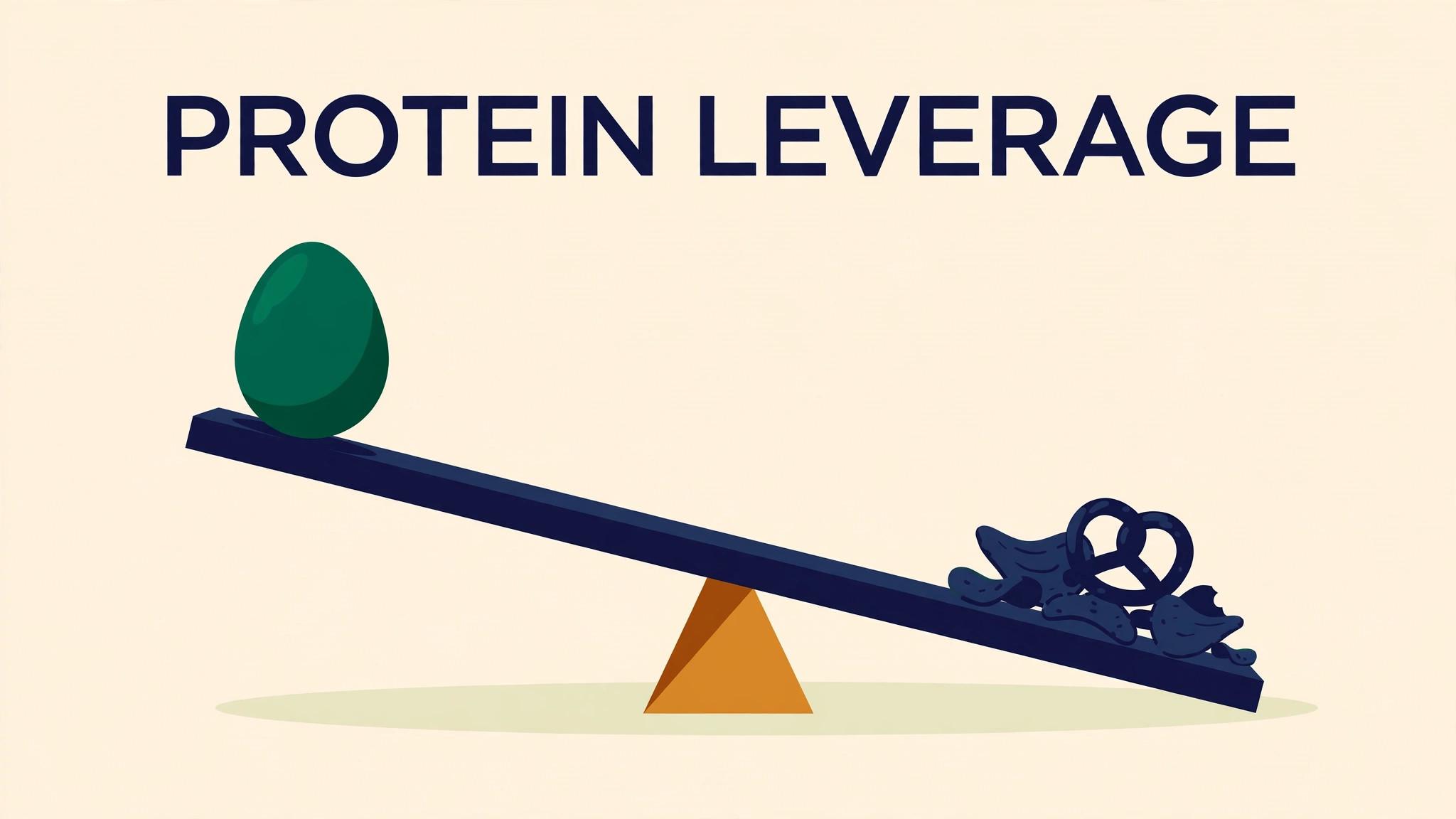
Featured image: custom illustration by Free Fitness Calculators.
The protein leverage hypothesis says your body defends a fixed protein target and keeps eating until it reaches it — so when food is low in protein, you overeat calories. The evidence is real but mixed: high-protein diets clearly reduce intake, but whether low-protein food drives overeating is still contested.
Here is a puzzle that has bothered nutrition researchers for decades. Across the world, and across very different diets, people eat roughly the same amount of protein — around 15% of their calories — and that share has barely moved during the obesity epidemic, even as total calorie intake has climbed. One influential idea says those two facts are connected: that the body defends a protein target, and when the food around us gets more dilute in protein, we eat more of everything to reach the same protein total. If that is true, the obesity epidemic is partly a protein-dilution problem — and the fix is not willpower but the protein share of the food supply.
That is the protein leverage hypothesis, proposed by Stephen Simpson and David Raubenheimer in 2005. It is one of the most interesting — and most argued-about — ideas in modern nutrition. This article explains what the hypothesis actually claims, walks through the human evidence study by study, and gives an honest verdict on where the evidence points. It is an analysis, not a diet pitch: the hypothesis may be partly right, and "partly right" is the interesting answer.
What the hypothesis actually says
The hypothesis starts from a simple observation. Animals, including humans, appear to regulate their protein intake more tightly than their intake of carbohydrate or fat. In their 2005 paper, Simpson and Raubenheimer noted that protein intake has remained near constant within and across populations during the obesity epidemic, at around 15% of dietary energy. Their proposal: the body has a protein target, and appetite stays switched on until that target is met. If the food available is rich in protein, the target is reached quickly and eating stops. If the food is dilute in protein — lots of carbohydrate and fat, little protein — the body has to eat much more total food to get the same protein, and the extra carbohydrate and fat calories come along for the ride.
The name "leverage" captures the maths. Because protein is a small share of the diet, a small change in its share levers a large change in total intake. Imagine your body wants 75 grams of protein a day. If your food is 15% protein, you reach that target at 2,000 calories. If your food is 10% protein, you need 3,000 calories to get the same 75 grams — a 50% increase in energy intake from a 5-percentage-point drop in protein share. That is the hypothesis's central prediction, and it is what makes it so provocative: a modest dilution of protein in the food supply could, in principle, drive a large rise in calorie intake without anyone deliberately overeating.
Two things are worth getting straight before looking at the evidence. First, the hypothesis is about protein share, not protein grams. Eating more protein in absolute terms is not the point; the point is the proportion of your calories that comes from protein. Second, the hypothesis makes an asymmetric prediction. It predicts both that low-protein diets cause overeating and that high-protein diets cause under-eating — but, as we will see, the evidence for those two directions is not equally strong, and that asymmetry is the heart of the debate.
The key experiment: Gosby 2011
The most cited test of the hypothesis in humans is a small but carefully designed trial by Alison Gosby and colleagues, published in 2011. Twenty-two lean volunteers lived in a research facility for three separate four-day periods. In each period they were offered the same 28 foods, matched for palatability and variety, but with the protein content set at 10%, 15% or 25% of energy. They could eat as much or as little as they wanted. The design was elegant: because the foods were the same and only the protein share changed, any difference in total intake could be attributed to protein.
The results were striking — and incomplete, in a revealing way. When protein was cut from 15% to 10% of energy, total energy intake rose by 12% (±4.5%), driven mostly by extra savoury snacks between meals. But that 12% rise was not enough to keep protein intake constant: the volunteers ate more, but still ended up eating less protein than on the 15% diet. Gosby's team called this "protein leverage is incomplete" — the body pushed back against protein dilution, but only part of the way. And when protein was raised from 15% to 25%, total energy intake did not change at all. The volunteers did not eat less on the high-protein diet, even though the hypothesis would predict they should.
The hunger data pointed the same way: on the fourth day, hunger one to two hours after breakfast rose by 1.6 points on the 10% protein diet, compared with 0.5 points on the 25% diet — suggesting low-protein eating leaves people hungrier sooner. So Gosby 2011 supports the hypothesis in its low-protein direction, with a caveat: the leverage is partial, not complete. But the study has real limits. It was short (four days per diet), small (22 people), confined to lean volunteers eating in a laboratory, and the high-protein arm showed no effect at all. A four-day trial cannot tell you what happens over months or years, and a laboratory cannot tell you what happens in a supermarket.
The pooled evidence: 38 trials
Single studies are suggestive; pooled studies are harder to dismiss. In 2014, Gosby and colleagues combined 38 published experimental trials in which people were allowed to eat freely on diets of varying protein content. The protein share across those trials ranged from 8% to 54% of energy — an enormous span, from very low to very high. The result was clear: the percentage of protein in the diet was negatively associated with total energy intake (F=6.9, P<0.0001), and the association held regardless of whether carbohydrate or fat was the nutrient that replaced the protein. In other words, it was the protein share itself that mattered, not what filled the gap. The authors concluded that the pooled data "strongly supports a role for protein leverage in lean, overweight and obese humans."
The shape of the relationship matters as much as its existence. The effect was strongest at lower protein percentages and flattened at higher ones: moving from 10% to 20% protein was associated with a much bigger drop in energy intake than moving from 20% to 30%. That flattening is consistent with a target-based mechanism — once you are comfortably above the protein target, adding more protein does not change appetite much further. It also means the hypothesis is most relevant at the low end of the protein range, where modern diets arguably sit: the practical question is not whether 40% protein beats 30%, but whether 12% protein drives more eating than 18%.
But a meta-analysis inherits the weaknesses of its parts: most of the 38 trials were short, many were small, and pooling them cannot fix the fact that laboratory eating is not real-world eating. The pooled result strengthens the case for leverage, but it does not settle it.
The high-protein side: Weigle 2005
The most dramatic demonstration of the high-protein side of the hypothesis came from David Weigle and colleagues in 2005. Nineteen volunteers followed a sequence of diets: two weeks on a weight-maintaining diet at 15% protein, two weeks on an isocaloric diet at 30% protein, then twelve weeks in which they could eat as much as they wanted on the 30% protein diet. Carbohydrate was held constant at 50% of energy throughout, so the extra protein replaced fat. The results were remarkable: spontaneous energy intake fell by 441 kcal per day, body weight fell by 4.9 kg, and fat mass fell by 3.7 kg over the twelve weeks — all without any instruction to eat less.
It is frequently cited as evidence for protein leverage, but its design has a significant limitation that is often glossed over: there was no control group. The volunteers went through the diets in sequence, so the weight loss and reduced intake could partly reflect the passage of time, the attention of being in a study, or the simple fact that people who sign up for a diet study tend to eat less. A 441 kcal/day drop is large — too large to explain away entirely — but the absence of a control group means the true size of the protein effect is uncertain. What Weigle 2005 establishes firmly is that a high-protein diet can reduce spontaneous intake substantially. What it does not establish is the other half of the hypothesis: that a low-protein diet drives overeating. For that, you need a study that tests the low-protein direction directly, with a proper control. That study exists — and it did not find what the hypothesis predicts.
The counter-evidence: Martens 2013
The study the hypothesis's critics reach for is a 2013 randomised crossover trial by Eveline Martens and colleagues. Seventy-nine volunteers — 40 men and 39 women — spent 12 days on each of three diets: 5%, 15% and 30% protein, with the protein coming from milk or plant sources. The 5% diet is extremely low in protein — far below what anyone would normally eat — so if protein leverage exists in the low-protein direction, this is where it should show up most clearly.
It did not. Total energy intake was 7.21 MJ per day (about 1,720 kcal) on the 30% protein diet, versus 9.33 MJ (about 2,230 kcal) on the 5% diet and 9.62 MJ (about 2,300 kcal) on the 15% diet. The high-protein diet reduced intake, exactly as the hypothesis predicts. But the very-low-protein diet did not increase intake relative to the normal-protein diet — the volunteers ate essentially the same number of calories on 5% protein as on 15%, and simply ended up eating much less protein. The authors' conclusion was blunt: "No evidence for protein leverage effects from diets containing a lower ratio of protein to carbohydrate + fat was obtained. It remains to be shown whether a relatively low protein intake would cause overeating or would be the effect of overeating of carbohydrate and fat."
That last sentence is the crux of the debate. The hypothesis says low protein causes overeating. Martens suggests the arrow may point the other way: people who overeat carbohydrate and fat end up with a low protein share as a consequence, not a cause. Both stories produce the same correlation — low protein share, high energy intake — but they imply very different fixes. Martens 2013 is a strong study: randomised, crossover (so each person served as their own control), reasonably large, and longer than Gosby's four-day periods. Its weakness is the same as every laboratory trial: 12 days is still short, and the 5% diet is so extreme that it may not reflect how people respond to the milder protein dilution of real-world food. But it is the best-designed direct test of the low-protein prediction, and it failed to find it.
The population test: ultra-processed food and the food supply
Laboratory trials test whether leverage can happen. Population data test whether it is happening. The most striking population evidence comes from ultra-processed food. In a 2018 analysis of NHANES 2009–2010 data covering 9,042 Americans, Eurídice Martínez Steele and colleagues found that as the share of ultra-processed food in the diet rose across quintiles, the protein content of the diet fell from 18.2% to 13.3% of energy — while total energy intake rose and absolute protein intake stayed relatively constant. That is precisely the pattern protein leverage predicts: people eating more total food to defend a roughly constant protein intake as the protein share of their diet falls. The authors concluded that "the protein-diluting effect of UPF might be one mechanism accounting for their association with excess energy intake."
The food-supply data tell a compatible story, with an important twist. In a 2019 perspective, Kevin Hall examined FAO food balance sheets and found that the absolute amount of protein in the US food supply has actually increased since the early 1970s — but its share of available calories has fallen by about 1%, because carbohydrate and fat availability grew faster. A 1% dilution sounds trivial, but the leverage maths makes it potentially significant: if the body defends a protein target, even a small dilution could drive a meaningful increase in total intake. Hall's verdict was carefully balanced: "While the protein leverage effect is unlikely to fully explain the obesity epidemic, its potential contribution should not be ignored."
Hall's position is worth noting because he had previously argued the other way: his 2018 paper concluded the evidence did not support the model, pointing out that two larger, longer studies had failed to reproduce the low-protein overeating effect. The 2019 perspective revises that view in light of the food-supply analysis — a reminder that this is a live scientific debate, not a settled question. The population data are consistent with leverage, but they are cross-sectional: they show patterns leverage would produce, not proof that leverage produced them.
The ultra-processed trial that complicates the story: Hall 2019
The strongest single piece of evidence in this whole debate — and the one that most complicates a simple leverage story — is Kevin Hall's 2019 inpatient trial at the NIH. Twenty weight-stable adults lived in a metabolic ward for two weeks on an ultra-processed diet and two weeks on an unprocessed diet. The diets were matched for presented calories, energy density, macronutrients, sugar, sodium and fibre. Participants could eat as much as they wanted. On the ultra-processed diet they ate 508 kcal per day more, gained 0.9 kg, and — on the unprocessed diet — lost 0.9 kg.
The protein numbers are the interesting part. Protein intake was essentially unchanged between the diets (a difference of −2 kcal per day, statistically indistinguishable from zero), while carbohydrate intake rose by 280 kcal per day and fat by 230 kcal per day. That pattern — total intake up, protein intake flat — is exactly what protein leverage predicts. But there is a catch: the diets were matched for macronutrients as presented, so the protein share of the food on offer was the same in both conditions. If leverage were the whole explanation, the matched protein share should have produced matched intake. It did not. Hall himself raised protein leverage as one possible contributor, alongside eating rate (people ate the ultra-processed food faster) and energy density — but the trial shows that something beyond protein share was driving the extra 508 calories.
Hall 2019 does not refute protein leverage. It shows that leverage, even if real, is not the only mechanism by which ultra-processed food drives overeating — and possibly not the largest one. The honest reading is that ultra-processed food overfeeds people through several channels at once: it is eaten faster, it is more energy-dense, and it is protein-dilute. Separating leverage's contribution from the others is the hard problem, and no single trial has done it yet.
Where the evidence points now: the verdict
| Study | What it tested | Result | What it means |
|---|---|---|---|
| Simpson & Raubenheimer 2005 | The hypothesis itself | Protein intake near constant at ~15% of energy across populations | The observation the hypothesis explains |
| Gosby 2011 | 10/15/25% protein, 4-day periods, 22 lean adults | 15%→10% raised intake 12%; 15%→25% no change; leverage incomplete | Supports low-protein leverage, partially |
| Gosby 2014 | 38 trials pooled, protein 8–54% | Protein share negatively associated with energy intake (P<0.0001) | Strongest pooled support for leverage |
| Weigle 2005 | 30% protein ad libitum, 19 adults, 12 weeks | Intake −441 kcal/day; weight −4.9 kg | High protein reduces intake; no control group |
| Martens 2013 | 5/15/30% protein crossover, 79 adults, 12 days each | High protein reduced intake; 5% did NOT increase intake vs 15% | Best test of low-protein leverage — found none |
| Martínez Steele 2018 | NHANES, 9,042 people | Protein share 18.2%→13.3% as UPF rose; energy up, protein flat | Population pattern consistent with leverage |
| Hall 2019 (trial) | UPF vs unprocessed, matched diets, 20 adults | UPF +508 kcal/day; protein intake unchanged | Consistent with leverage, but other mechanisms at work |
| Hall 2019 (perspective) | FAO food-supply data | Protein share of US food supply down ~1% since the 1970s | Small dilution, potentially large leverage |
| Kebbe 2023 | Protein balance vs energy intake, 41 pregnant women with obesity | No significant association (p=0.30) | No leverage in this population |
Step back, and the shape of the evidence is clear. The high-protein direction is well supported: raising protein share reduces spontaneous energy intake, in short trials, in pooled data, and in a 12-week study. The low-protein direction — the one that would explain the obesity epidemic — is where the evidence splits. Short trials and pooled data support it; the best-designed crossover trial and a pregnancy cohort did not find it. The population data are consistent with it but cannot prove it. The fairest summary is this: protein leverage is a real, measurable effect, but it is partial rather than complete, and it is one mechanism among several — not the single explanation for why people overeat.
What it would mean practically if true
If the hypothesis is right — even partly right — it changes how you think about eating, in two ways. First, it shifts attention from protein grams to protein share. Two diets can deliver the same 80 grams of protein, but if one delivers it in 1,600 calories and the other in 2,400, the hypothesis says the second one will leave you hungrier, because your body is still chasing the same protein target through more dilute food. That is an argument for protein at every meal and for foods that are protein-dense rather than protein-dilute — and it is one reason the same total protein can feel very different depending on what it comes with.
Second, it reframes ultra-processed food. If protein dilution is one of the ways processed food drives overeating, then the fix is not only to eat less of it but to notice what it displaces: meals built around protein-rich whole foods tend to be more satiating per calorie, which is the same advice good nutrition guidance gives for other reasons. Our protein calculator can estimate your daily protein target from your weight and activity level, and our macro calculator shows how that target fits into your overall calorie budget — the protein intake guide and complete guide to tracking macros explain both in detail.
But the conditional matters. The hypothesis is contested, the low-protein direction is the uncertain half, and nobody should rebuild their diet around a mechanism that the best-designed trial failed to find. The practical advice that follows from protein leverage — eat enough protein, favour whole foods over ultra-processed ones, include protein at each meal — is also the advice that follows from the established evidence on satiety and diet quality. That convergence is reassuring: you do not need the hypothesis to be true to benefit from acting as if it were, and you do not need to push protein to extreme levels to do so.
Frequently asked questions
Does eating more protein always reduce appetite?
Not always, and not without limit. The evidence shows that raising protein share reduces spontaneous energy intake up to a point, with the effect flattening at higher protein levels — going from 10% to 20% protein matters more than going from 20% to 30%. Protein also increases satiety through mechanisms beyond leverage, including its higher thermic effect and its effects on satiety hormones. But appetite is influenced by many factors — sleep, stress, food palatability, eating speed — and protein is one lever among several.
Is protein leverage the same as the thermic effect of protein?
No. The thermic effect is the energy your body spends digesting and processing protein — roughly 20–30% of protein calories, compared with around 5–10% for carbohydrate and 0–3% for fat. Protein leverage is a separate idea: that the body regulates its protein intake and keeps eating until a protein target is met. Both effects point in the same direction (protein-rich diets tend to favour lower net energy intake), but they are different mechanisms, and the evidence for each should be judged separately.
If I eat 30% protein, will I automatically eat less?
Probably, but not certainly — and the evidence is clearer for the direction than for the size of the effect. In Weigle 2005, a 30% protein diet cut spontaneous intake by 441 kcal per day, but that study had no control group. In Martens 2013, a 30% protein diet cut intake by roughly 500–580 kcal per day compared with 5% and 15% protein diets, in a controlled crossover. In Gosby 2011, raising protein from 15% to 25% did not change intake at all over four days. The most defensible expectation is a meaningful but variable reduction, not a fixed number.
Does the hypothesis apply to weight loss, or only to overeating?
It applies to both, because it is a claim about how protein share regulates total intake. In the weight-loss direction, the evidence is stronger: high-protein diets consistently reduce spontaneous intake, which is one reason they are a mainstay of weight-loss advice. In the overeating direction, the evidence is contested: whether low-protein food actively drives overeating, or whether overeating of carbohydrate and fat merely dilutes protein share as a side effect, is the unresolved question at the heart of the hypothesis.
This article is educational and is not medical advice. Nutrition needs vary from person to person, and the right approach depends on your own health, goals and circumstances — if you are considering a significant change to your diet, please speak to a doctor or a registered dietitian.