

Introduction: The "Invisible Engine" Problem
Imagine two people, "Mike" and "Dave." They are the exact same height (6'0"), the exact same age (32), and they follow the exact same diet protocol, eating precisely 2,500 calories per day. They even follow the same workout program.
On paper, their results should be identical. The math says so.
Yet, after six months, the reality is starkly different. Mike has shredded down to 12% body fat, revealing defined abs and vascularity. Dave, on the other hand, has gained 8 pounds of soft weight and feels lethargic. Dave blames his "bad genetics." Mike claims he’s just "working harder."
Science tells us they are both wrong. The variable isn't luck, and it often isn't even "work ethic" in the traditional sense. The variable is the efficiency and output of their Metabolic Engine.
For decades, the fitness industry has treated metabolism like a mysterious black box—something you were born with, destined to be either "fast" or "slow," with no hope of changing it. This fatalistic view has destroyed millions of health journeys before they even began.
Welcome to The Ultimate Metabolism Guide for 2026.
In this comprehensive resource, we are dismantling the myths. We are moving beyond the simplistic "Calories In, Calories Out" model to explore the complex, adaptive, and highly manageable system that is your metabolism. You will learn the physics behind Basal Metabolic Rate (BMR), the overlooked power of Non-Exercise Activity Thermogenesis (NEAT), and the hormonal levers you can pull to turn your body from a storage depot into a burning furnace.
It is time to stop guessing. It is time to look under the hood.
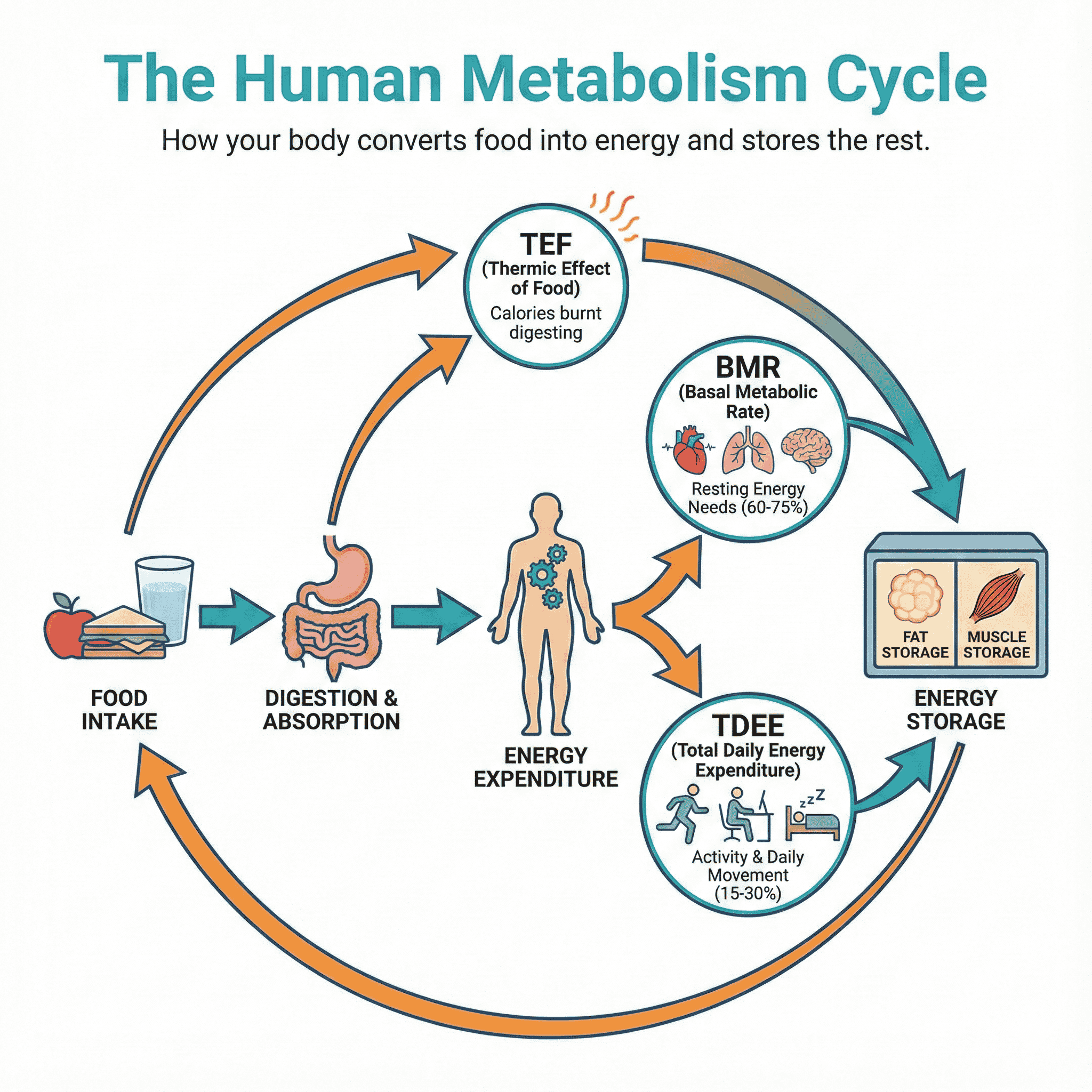
Human body metabolism diagram showing BMR, NEAT, and TEF energy systems 2026.
Chapter 1: Deconstructing the Engine (What is Metabolism?)
In strictly biological terms, metabolism is the sum of every chemical reaction that occurs within your body to maintain life. It is the process of converting the fuel you eat (proteins, fats, and carbohydrates) into the energy (ATP) your cells need to breathe, circulate blood, repair tissues, and contract muscles.
However, for the purpose of weight management and fitness, "metabolism" refers to your Total Daily Energy Expenditure (TDEE). This is the total number of calories your body burns in a 24-hour cycle.
To master your weight, you must understand that TDEE is not one single number. It is a pie chart made of four distinct slices. If you only focus on one slice (like the treadmill), you miss 80% of the picture.
1. Basal Metabolic Rate (BMR) – The "Idle" Burn
Contribution: ~60% to 75% of total burn.
The Science: This is the energy cost of keeping you alive. If you laid in a dark room in a coma for 24 hours, this is how many calories you would burn. Your brain demands roughly 20% of this energy alone. Your liver, heart, and kidneys are also massive energy hogs.
The Lever: BMR is heavily influenced by your body size and composition. A 200lb person has a higher BMR than a 150lb person simply because there is more tissue to support. Crucially, muscle tissue is more metabolically active than fat tissue, burning roughly 6 calories per pound per day at rest, compared to fat's 2 calories per pound.
2. Non-Exercise Activity Thermogenesis (NEAT) – The "Hidden" Burn
Contribution: ~15% to 30% of total burn.
The Science: This is the energy burned by everything that isn't sleeping, eating, or "gym exercise." It includes walking to the car, typing, fidgeting, standing, cooking, and maintaining posture.
The Lever: This is the most variable component. A sedentary office worker might burn 300 calories via NEAT, while a construction worker or waiter might burn 2,000+. This is often the "secret" reason why some people stay skinny without trying—they simply move more constantly.
3. Thermic Effect of Food (TEF) – The "Processing" Cost
Contribution: ~10% of total burn.
The Science: Digestion is work. Your body must chemically break down food, absorb nutrients, and store them. This costs energy.
The Lever: Not all calories are created equal here.
Fats: Very easy to digest (0-3% energy loss).
Carbs: Moderate effort (5-10% energy loss).
Protein: High effort (20-30% energy loss).
Translation: If you eat 100 calories of protein, your body only "nets" about 70-80 calories. The rest is lost as heat during digestion. This is why high-protein diets are metabolically superior.
4. Exercise Activity Thermogenesis (EAT) – The "Training" Burn
Contribution: ~5% to 10% of total burn.
The Science: This is your planned workout: the 45 minutes of lifting, the 3-mile run, the spin class.
The Lever: Ironically, this is the smallest piece of the pie for most people, yet it's the one we obsess over. You cannot "out-train" a diet because an hour of hard running might burn 600 calories, which is easily erased by one large frappuccino.
Chapter 2: The Math of Maintenance (Calculations)
To optimize your metabolism, you must first quantify it. You cannot improve a metric you are not tracking. We use specific formulas to estimate these numbers with high accuracy.
Step 1: Finding Your BMR
The most widely respected formula for calculating BMR in 2026 is the Mifflin-St Jeor Equation. It has consistently proven more accurate than the older Harris-Benedict method.
The Formula (Men): (10 × weight in kg) + (6.25 × height in cm) - (5 × age in years) + 5
The Formula (Women): (10 × weight in kg) + (6.25 × height in cm) - (5 × age in years) - 161
Do not worry about the manual math. Use our BMR Calculator to get your number instantly.
Step 2: Determining Your Activity Multiplier (PAL)
Once you have your BMR, you must multiply it by your Physical Activity Level (PAL) to find your TDEE. Be honest here—most people overestimate their activity.
Sedentary (BMR x 1.2): Desk job, little to no exercise. (Most people fall here).
Lightly Active (BMR x 1.375): Light exercise 1-3 days/week.
Moderately Active (BMR x 1.55): Moderate exercise 3-5 days/week.
Very Active (BMR x 1.725): Heavy exercise 6-7 days/week.
Super Active (BMR x 1.9): Physical job + heavy training.
Step 3: The TDEE Result
Your BMR x PAL = TDEE. This is your "Maintenance Calories." If you eat this amount, your weight stays the same. Use the TDEE Calculator to run these numbers automatically.
Chapter 3: Metabolic Adaptation (Why "Starvation Mode" is a Half-Truth)
One of the most persistent myths in fitness is "Starvation Mode"—the idea that if you skip breakfast, your body immediately stops burning fat. This is false. However, the kernel of truth inside it is a very real phenomenon called Adaptive Thermogenesis.
Your body creates a "set point" for its weight. When you aggressively cut calories to lose weight, your body views this as a survival threat (famine). It fights back to keep you alive.
The Hormonal Cascade
When you are in a steep caloric deficit for too long, a specific hormonal cascade occurs:
Leptin Plummets: Leptin is the "satiety hormone" produced by fat cells. As you lose fat, leptin levels drop, signaling your brain that energy stores are low. This creates voracious hunger.
Ghrelin Spikes: The "hunger hormone" increases, making you fixate on food.
Thyroid Downregulation: Your body lowers the production of T3 (Triiodothyronine), the active thyroid hormone that regulates the speed of your metabolism. This effectively "turns down the thermostat" on your BMR.
NEAT Decreases: Subconsciously, you stop fidgeting. You sit more. You procrastinate on chores. Your body is hoarding energy.
The "Biggest Loser" Effect
A famous 2016 study on contestants from The Biggest Loser showed that years after losing massive amounts of weight rapidly, their RMRs were suppressed by an average of 500 calories per day below what would be expected for their size. Their bodies were still fighting to regain the lost weight.
The Solution: This is why "crash diets" fail 95% of the time. The 2026 approach to fat loss relies on Metabolic Periodization—taking diet breaks, using "re-feeds," and avoiding aggressive deficits to keep the metabolic flame burning high.
Chapter 4: Assessing Your Metabolic Health
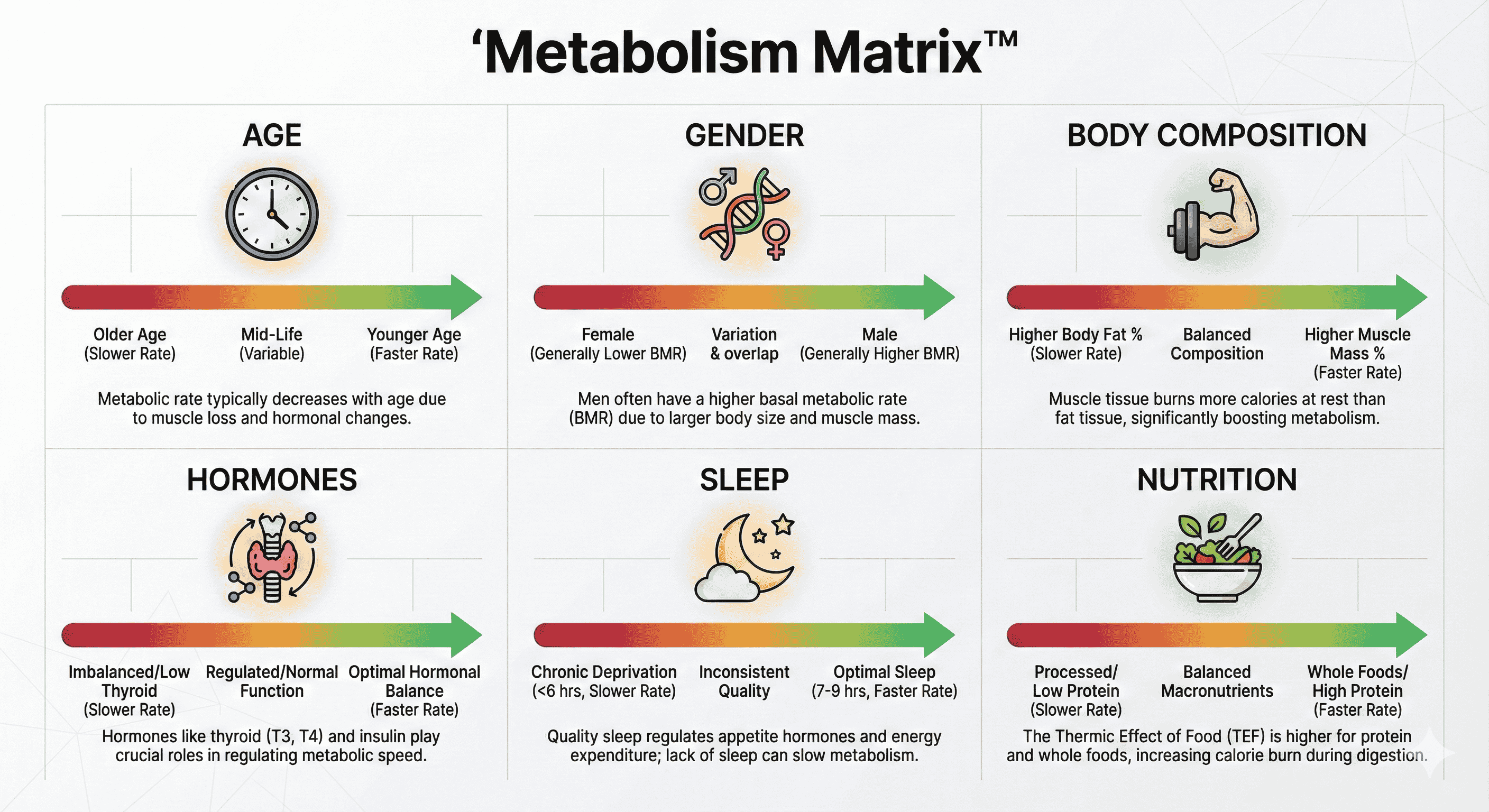
Metabolism Matrix chart showing how age, gender, hormones, and sleep affect metabolic rate.
Before we move to the "Boosting" protocols in Part 2, we need to assess where you stand right now. Are you Mike, or are you Dave?
The "Metabolic Temperature" Check
You can gauge the health of your metabolism without a lab coat by tracking these biofeedback markers:
Body Temperature: A robust metabolism generates heat. If your hands and feet are constantly freezing, or your waking body temperature is consistently below 97.5°F (36.4°C), it may indicate a downregulated thyroid or low metabolic rate.
Libido: Reproduction is an "expensive" biological luxury. If energy intake is too low, libido is the first system to shut down. High libido generally correlates with high metabolic health.
Digestion: Regularity implies a well-fueled system. Constipation or bloating can signal a slowed metabolic transit time.
Energy Stability: Do you crash at 2 PM? A flexible metabolism can switch between burning carbs and body fat for fuel seamlessly. If you "crash," you may lack Metabolic Flexibility.
The Math Check (Metabolic Damage Test)
Calculate your predicted TDEE using our TDEE Calculator.
Track your actual calorie intake and weight for two weeks.
The Comparison:
If you are eating at your predicted TDEE and maintaining weight: Normal Metabolism.
If you are eating significantly below your predicted TDEE (e.g., 500+ calories less) and still not losing weight: Downregulated Metabolism (Adapted).
If you fall into the "Downregulated" category, simply cutting more calories is not the answer. That is a race to the bottom you cannot win. You need the Metabolic Repair Protocol.
Chapter 5: The 2026 Boosting Protocols (The 4 Pillars)
You cannot "hack" your metabolism with a pill or a detox tea. However, you can structurally change how your body processes energy. To do this, we rely on four science-backed levers.
Pillar 1: Hypertrophy (Building the Furnace)
If there is a "magic pill" for metabolism, it is muscle mass. In 2026, we no longer view muscle just as "strength" or "aesthetics"—we view it as the Organ of Longevity.
The Math: Muscle tissue is approximately 3-4 times more metabolically active than fat tissue at rest. While the old myth that "1 pound of muscle burns 50 calories a day" was an exaggeration, the systemic effect of muscle is profound.
The "Afterburn" Effect (EPOC): Strength training damages muscle fibers. Repairing this damage requires massive amounts of energy for 24-48 hours after the workout ends. This is Excess Post-Exercise Oxygen Consumption (EPOC). Cardio does not produce this effect to the same degree.
Glucose Disposal: Muscle acts as a "sink" for carbohydrates. The more muscle you have, the more places your body can store glycogen (carbs) without turning them into fat.
The Protocol:
Frequency: 3 to 4 days per week.
Focus: Progressive Overload (adding weight or reps over time).
Selection: Compound movements (Squats, Deadlifts, Presses) recruit the most muscle mass, triggering the highest metabolic response.
Pillar 2: TEF Optimization (Protein Pacing)
You can literally boost your metabolism by eating. As discussed in Chapter 1, the Thermic Effect of Food (TEF) varies wildly by macronutrient.
The Protein Advantage: Protein has a TEF of 20-30%. This means if you eat 100 calories of chicken breast, your body uses 25 of those calories just to digest it.
The Satiety Factor: Protein triggers the release of hormones like PYY and GLP-1, which suppress appetite. You burn more and feel fuller.
The Protocol:
Quantity: Aim for 0.8g to 1g of protein per pound of goal body weight. (Use our Protein Calculator to find your number).
Timing: "Protein Pacing"—spreading intake evenly across 3-4 meals—keeps muscle protein synthesis (building mode) active all day.
Pillar 3: NEAT Hacking (The Lifestyle Shift)
This is the single biggest differentiator between the "naturally skinny" and the "stuck."
The Problem: The modern world is engineered for sedation. We sit in cars, sit at desks, sit on sofas. This drops NEAT to near zero.
The Solution: You don't need more gym time; you need more movement time.
The Protocol:
The 10k Step Rule: It’s not arbitrary. 8,000–10,000 steps a day ensures your body never fully settles into "sedentary mode."
Standing vs. Sitting: Standing burns ~30-50% more calories per hour than sitting. Over a year, using a standing desk for 4 hours a day can result in 10+ pounds of fat loss equivalent expenditure.
Fidgeting: Believe it or not, tapping your feet and pacing while on the phone can burn an extra 300 calories a day.
Pillar 4: Chronobiology (Sleep & Circadian Rhythm)
Your metabolism has a bedtime.
The Science: Sleep deprivation sends a "stress signal" to the body. Cortisol (stress hormone) spikes, which encourages muscle breakdown and visceral fat storage. simultaneously, Insulin Sensitivity drops, meaning the food you eat is more likely to be stored as fat.
The Protocol:
Duration: 7-9 hours of quality sleep.
Darkness: Artificial light at night disrupts melatonin, which is linked to metabolic regulation.
Fasting Window: Stop eating 2-3 hours before bed. Eating right before sleep forces your body to digest when it should be repairing, lowering sleep quality and metabolic efficiency.
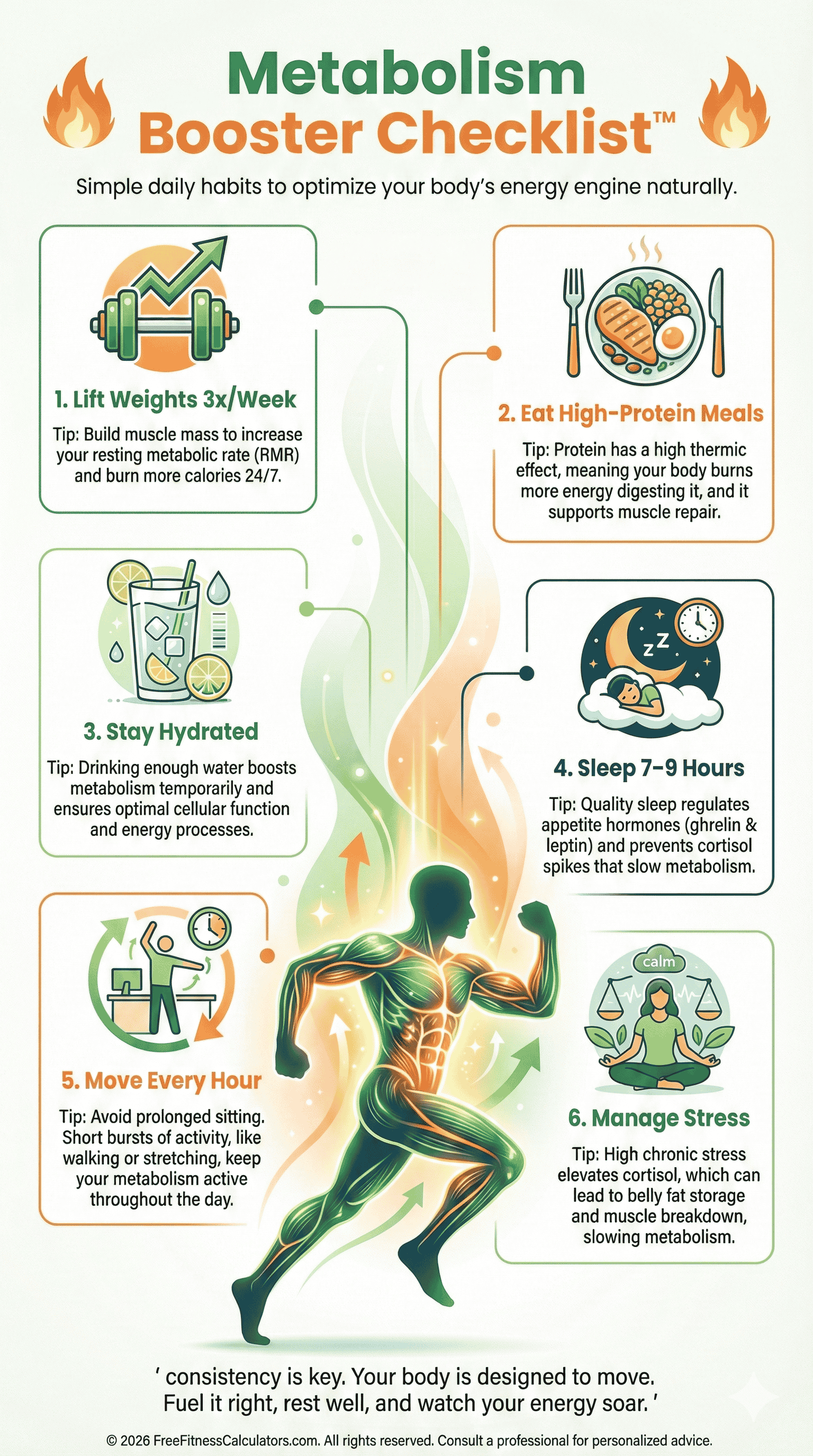
Infographic showing the human metabolism cycle: digestion, energy use, and fat storage flow.
Chapter 6: The Metabolic Repair Protocol (Reverse Dieting)
What if you have already "damaged" your metabolism? What if you are eating 1,200 calories and not losing weight?
You need a Reverse Diet.
This is a strategic, slow increase in calories designed to "teach" your body to burn more fuel again, reversing the effects of metabolic adaptation.
Phase 1: The Assessment
Track your current intake honestly for 7 days. Do not change anything.
Calculate your average daily calories. Let's say it's 1,400, but your predicted TDEE (from our calculator) should be 2,200. This gap confirms adaptation.
Phase 2: The Climb
You cannot jump straight to 2,200, or you will gain rapid fat. You must go slowly.
Week 1: Add 100 calories to your daily average (mostly from carbs/protein). New total: 1,500.
Week 2: Monitor weight. If stable (or increased <0.5 lbs), add another 50-100 calories. New total: 1,600.
Week 3-10: Repeat.
Phase 3: The Ceiling
Eventually, you will reach your "Predicted TDEE" (2,200) while maintaining roughly the same weight.
The Magic: You are now eating 800 calories more per day than when you started, but you haven't gained significant fat. Your BMR has upregulated. Your thyroid is happy. You have energy.
The Next Step: Now, you can enter a healthy cutting phase. You drop to 1,900 calories (a 300 deficit). Since your metabolism is firing high, the weight will fall off effortlessly.
Chapter 7: Metabolic Flexibility (The 2026 Frontier)
The buzzword for 2026 isn't just "speed"—it's Flexibility.
Metabolic Flexibility is your body's ability to switch seamlessly between fuel sources.
Carb Burner: When you eat carbs, your body uses them immediately.
Fat Burner: When you haven't eaten (or are doing low-intensity work), your body taps into fat stores.
The Inflexible Metabolism: This person eats a bagel, spikes insulin, and runs on sugar. Two hours later, blood sugar drops. Instead of switching to burning body fat, their brain panics (brain fog, "hangry," shakes) and demands more sugar. They are stuck on the "glucose rollercoaster."
How to Train Metabolic Flexibility:
Zone 2 Cardio: Long, slow cardio (where you can hold a conversation) trains your mitochondria to prioritize fat oxidation.
Intermittent Fasting: Short windows of fasting (12-16 hours) force the body to practice mobilizing stored fat.
Cyclical Ketosis: Occasionally lowering carbs for a few days can "remind" your enzymatic machinery how to process ketones.
Chapter 8: Myths vs. Reality (Supplement Edition)
The market is flooded with "Fat Burners" and "Metabolism Boosters." Do they work?
Caffeine: Yes. It boosts epinephrine and can increase BMR by 3-11% temporarily. It also increases NEAT (makes you want to move).
Green Tea Extract (EGCG): Mild effect. Might increase fat oxidation by small percentages during exercise.
Capsaicin (Spicy Food): Very minor thermogenic effect. Not significant for weight loss.
L-Carnitine: Aids in transporting fatty acids into mitochondria, but supplementation is mostly useful only if you are deficient.
"Fat Burner Pills": Generally useless. Most are just high doses of caffeine. They cannot fix a bad diet.
The Verdict: The best "supplement" is sleep, creatine (for muscle building), and protein powder (to hit TEF goals).
Conclusion: You Are The Mechanic
The era of blaming your "slow metabolism" ends today.
We have learned that while genetics deal the cards, you play the hand.
You control your BMR through muscle mass.
You control your NEAT through daily movement.
You control your TEF through protein intake.
You control your Hormones through sleep and stress management.
Your metabolism is not a curse. It is a machine that requires maintenance. If you treat it like a Ferrari—fueling it with premium protein, tuning it with sleep, and driving it with exercise—it will perform like one. If you let it rust in the garage (sedentary life) or starve it of oil (crash diets), it will seize up.
Your Action Plan for Today:
Calculate: Use the BMR Calculator and TDEE Calculator to find your numbers.
Lift: Schedule three heavy lifting sessions this week.
Eat: Hit your protein goal every single day.
Move: Get 8,000 steps, no excuses.
The math works if you do.