
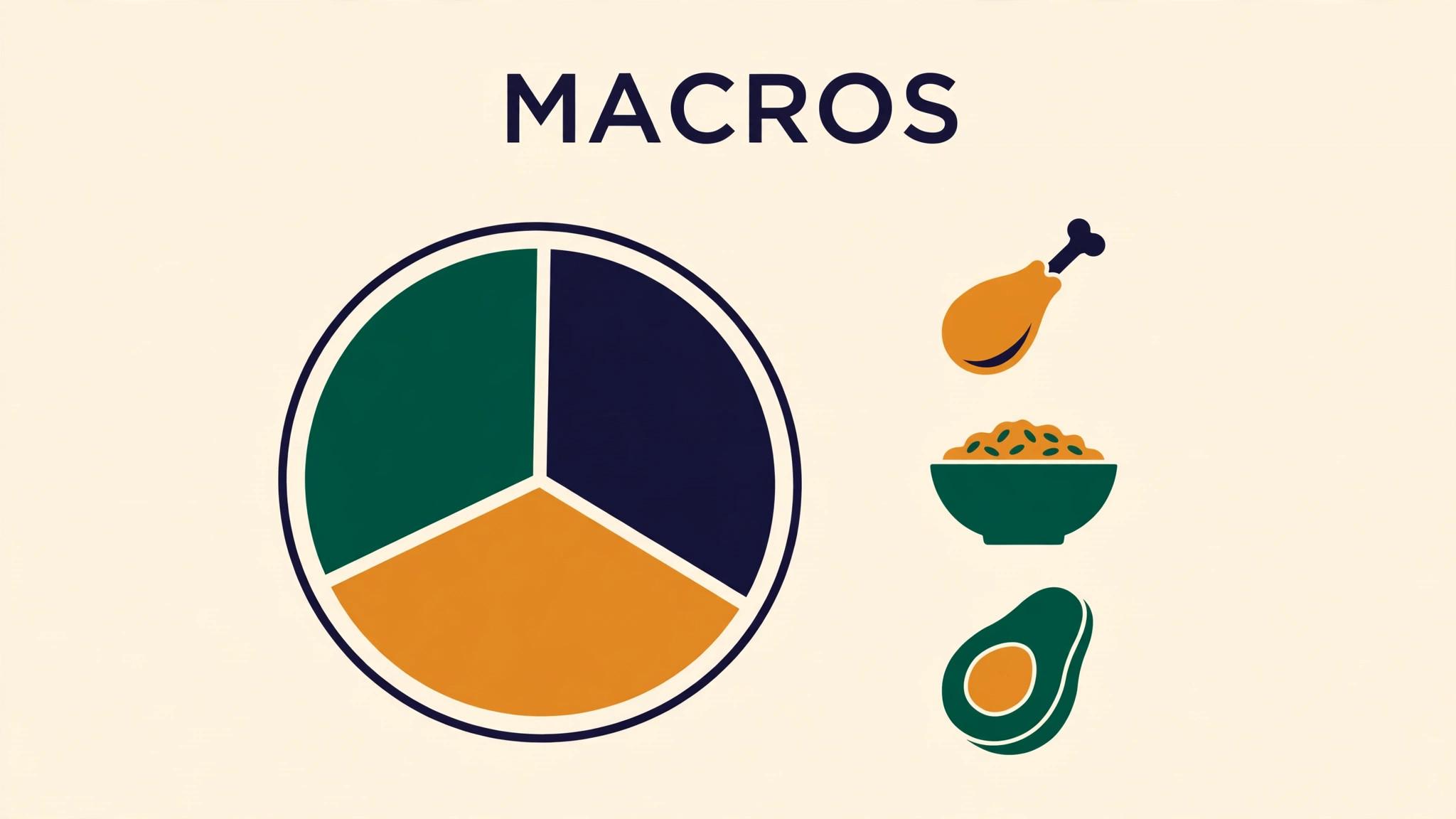
Featured image: custom illustration by Free Fitness Calculators.
Your daily macros are your calorie target split three ways: protein and carbohydrate at 4 calories per gram, fat at 9. A macro calculator estimates how many calories you burn each day from your age, weight, height, activity level and goal, then divides that total by your split — the balanced default is 25% protein, 45% carbohydrate and 30% fat.
What macros are
"Macros" is short for macronutrients: protein, carbohydrate and fat, the three nutrients that supply your body's energy. Counting calories decides whether you lose or gain weight; counting macros shapes what that change is made of — protein helps you hold on to muscle while dieting, and fat supports hormones and vitamin absorption.
Each macro has a fixed energy value, known as the Atwater factors: protein provides 4 calories per gram, carbohydrate 4 calories per gram, and fat 9 calories per gram. Those three numbers are the whole arithmetic of macro counting: divide each macro's calories by its per-gram value to get grams.
How the calculator works
Our macro calculator works in three steps. First it estimates your basal metabolic rate (BMR) — the calories your body burns at complete rest — from your age, sex, height and weight. The default equation is Mifflin-St Jeor, developed in 1990 from measurements on 498 healthy adults; you can switch to revised Harris-Benedict or, if you know your body fat percentage, to Katch-McArdle, which uses lean body mass instead of total weight.
Second, it multiplies your BMR by an activity factor to estimate your total daily energy expenditure (TDEE): 1.2 for sedentary, 1.375 for light activity, 1.55 for moderate, 1.725 for active, 1.9 for very active and 2.0 for extra active. Be honest here — overestimating activity is the most common reason a macro plan stalls. You can check the figure on its own with our TDEE calculator.
Third, it adjusts for your goal: maintenance keeps your TDEE as the target, weight loss subtracts 250, 500 or 1,000 calories a day (roughly 0.25, 0.5 or 1 kg a week), and weight gain adds the same amounts, with a floor of 800 calories a day. Only then does it split the target into protein, carbohydrate and fat.
The four preset splits
The tool offers four preset splits, each adding up to 100% of your calories:
| Preset | Protein | Carbohydrate | Fat | Best for |
|---|---|---|---|---|
| Balanced | 25% | 45% | 30% | General health |
| Low fat | 25% | 55% | 20% | Carb-rich eating |
| Low carb | 30% | 35% | 35% | Lower-carb eating |
| High protein | 35% | 40% | 25% | Muscle and dieting |
How do these compare with official guidance? The Institute of Medicine's Acceptable Macronutrient Distribution Ranges (AMDRs) for adults are carbohydrate 45–65% of calories, protein 10–35% and fat 20–35%. The balanced preset sits inside all three bands, and so do the low-fat and high-protein presets. The low-carb preset's 35% carbohydrate sits below the AMDR floor — a deliberate trade-off, not a default to drift into unknowingly.
Setting protein by body weight
Many people set protein from body weight instead, because protein needs track your size more than your calorie intake. The calculator's custom mode does exactly that: it defaults to 1.8 grams of protein per kilogram of body weight, lets you set fat as a percentage (30% by default), and fills the remaining calories with carbohydrate automatically.
The tool's own guidance puts muscle-building intakes at 1.6–2.2 g/kg a day, and a 2018 meta-analysis of 49 resistance-training trials found intakes above about 1.6 g/kg added no further gains in fat-free mass. For comparison, the basic recommended dietary allowance for sedentary adults is 0.8 g/kg a day — a floor for adequacy, not a target for training. If you want to check protein on its own, our protein calculator works through the same numbers.
Worked example: a 30-year-old man, moderately active
Take a man, age 30, weighing 80 kg and 180 cm tall, moderately active, maintaining his weight. His BMR by Mifflin-St Jeor is 10 × 80 + 6.25 × 180 − 5 × 30 + 5 = 1,780 calories a day. Multiplied by the moderate activity factor of 1.55, his TDEE is 2,759 calories a day — and because his goal is maintenance, that is his target.
On the balanced preset, the split works out as follows:
| Macro | Share | Calories | Grams |
|---|---|---|---|
| Protein | 25% | 690 | 172 g |
| Carbohydrate | 45% | 1,242 | 310 g |
| Fat | 30% | 828 | 92 g |
Protein is 25% of 2,759 calories divided by 4 calories per gram (172 g); carbohydrate is 45% divided by 4 (310 g); fat is 30% divided by 9 (92 g). If the same man switched to the standard weight-loss goal, his target would drop by 500 calories to 2,259 a day, and the same split would give 141 g of protein, 254 g of carbohydrate and 75 g of fat. In custom mode at 1.8 g/kg, his protein target would be 144 g (1.8 × 80 kg) before fat and carbohydrate are worked out.
Picking a split — and when to change it
Start with balanced unless you have a reason not to: it fits the AMDR bands and gives every macro a meaningful share. Move to high-protein when dieting hard or training for muscle; move to low-carb if carbohydrate-heavy meals leave you hungry soon after. Whichever you choose, judge it over three or four weeks of consistent tracking — weight trend, training performance and hunger — before changing anything. A split you can follow beats a theoretically better one you abandon.
Frequently asked questions
How do I calculate my macros?
Estimate your TDEE, adjust it for your goal, then divide the calories by your chosen percentages and convert to grams at 4 calories per gram for protein and carbohydrate, 9 for fat. Our macro calculator does all three steps for you.
What is a good macro split for weight loss?
Start with the balanced split — 25% protein, 45% carbohydrate, 30% fat — or the high-protein preset at 35% protein if you train regularly. The deficit drives the weight loss; the split shapes how much of it is fat rather than muscle.
How much protein do I need per day?
For general health, the RDA is 0.8 g per kilogram of body weight. Active people building muscle generally aim for 1.6–2.2 g/kg, and research suggests intakes above about 1.6 g/kg add little extra muscle for most lifters.
Should my macros change on rest days?
Some athletes eat more carbohydrate on training days and more fat on rest days (carb cycling). For most people, keeping the same targets every day is simpler and works just as well.
This guide is general information, not medical advice. Talk to a doctor or a registered dietitian before changing your diet significantly, especially if you have diabetes, kidney disease, an eating disorder, or take medication that affects appetite or metabolism.