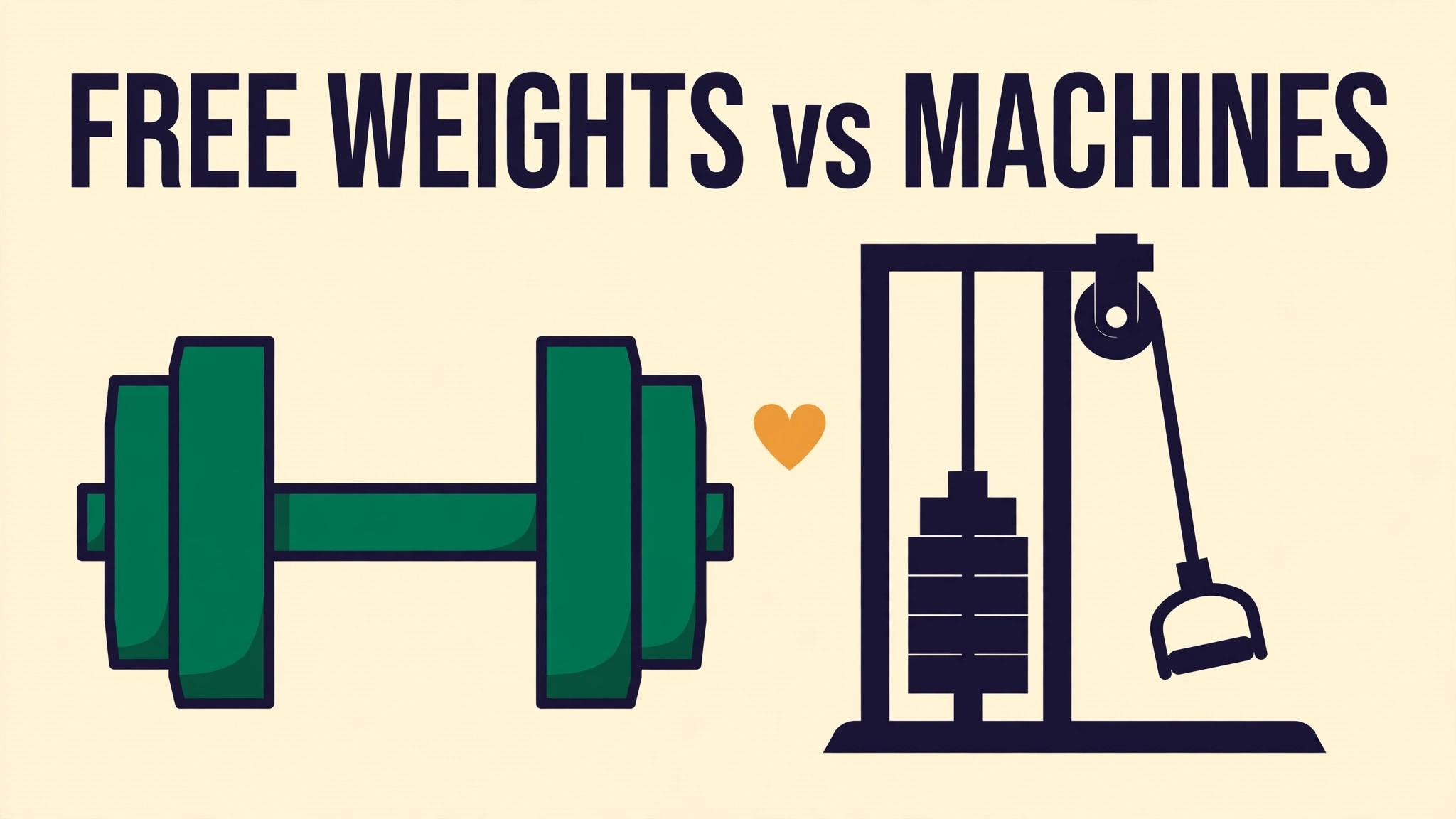
Featured image: custom illustration by Free Fitness Calculators.
For building muscle, free weights, machines and bodyweight exercises work about equally well when your sets are hard and close to failure. Strength gains are more specific: you get strongest at the exercises you actually practise. The best choice is the one that fits your goal, your experience and your life — and the one you will keep doing.
Walk into any gym and you will hear confident opinions: free weights are the only serious way to train; machines are safer and just as good; bodyweight training cannot build real muscle. Each claim contains a grain of truth and a larger helping of folklore. The research is now substantial enough to sort out which parts hold up — and the picture is more forgiving than the arguments suggest.
This article compares the three on the questions that matter: muscle growth, strength, skill demands, injury risk, and who each suits. The evidence comes from meta-analyses and trials — and where it runs out, this article says so.
What each modality actually is
Free weights are barbells, dumbbells and kettlebells — loads you hold in your hands or rest on your body, with nothing guiding their path. You control the weight in every direction, which means the muscles that stabilise your joints work alongside the muscles doing the lifting. A barbell squat, a dumbbell press and a kettlebell row are all free-weight exercises.
Machines guide the resistance along a fixed path. In the research literature, machine-based training usually means pin-loaded weight-stack equipment: the leg press, the chest press machine, the lat pulldown, the Smith machine. The machine stabilises the load for you, so the target muscles do the work with less help — and less demand — from the stabilisers around them.
Bodyweight training uses your own body as the load: push-ups, pull-ups, squats, lunges, planks, dips. Difficulty is changed by altering leverage (feet elevated for a harder push-up, for example), tempo, range of motion, or the number of repetitions — rather than by adding plates to a bar.
Muscle growth: the evidence says the tool matters less than the effort
The most useful finding in this whole debate is also the least dramatic: when researchers directly compare free weights and machines for muscle growth, they find no meaningful difference.
A 2023 systematic review and meta-analysis pooled 13 studies with 1,016 adults who trained with free weights or machines for at least six weeks. For hypertrophy, the pooled effect was essentially zero (standardised mean difference −0.055) — neither modality came out ahead, and the authors concluded the choice comes down to individual preference and goals. An earlier 2022 meta-analysis reached the same conclusion (effect size −0.01). Two independent syntheses, same answer: for building muscle, the implement does not decide the outcome.
A 2017 meta-analysis of 21 studies offers the mechanism. It compared low-load training (60% of one-rep max or less) with high-load training (more than 60%), with all sets taken to momentary muscular failure. Muscle growth was similar across the loading range. Heavy weights were better for maximal strength — more on that below — but for hypertrophy, what mattered was taking sets close to failure, not the size of the load. That is why bodyweight training can build muscle too: a hard set of push-ups taken near failure provides a similar growth stimulus to a hard set of bench press, provided the effort is genuinely comparable.
That is not just theory. In a 2017 trial, 18 young men trained twice a week for eight weeks, one group bench pressing at 40% of their one-rep max and the other doing push-ups adjusted to the same load. Both groups gained strength and muscle thickness to a similar degree. One detail is worth noting: biceps thickness increased only in the bench-press group, a reminder that one bodyweight exercise does not always train every muscle a barbell exercise reaches.
There are honest limits. Most comparative trials lasted six to twelve weeks with young, mostly untrained men, so long-term results and results in older or highly trained lifters are less certain. The bodyweight evidence is the thinnest: one small eight-week trial plus the load-range logic. Still, the direction is consistent: muscle grows in response to hard, progressive training, and the tool is a secondary decision.
The principle tying this together is progressive overload — gradually increasing the demand on your muscles. The American College of Sports Medicine's position stand recommends increasing the load by 2–10% once you can perform one to two repetitions more than your target, and that rule applies whether the load is a barbell, a weight stack, or your own body in a harder leverage position.
Strength: specific to what you practise
Strength is where the modalities start to separate — but not in the way most people expect. The pattern in the research is specificity: you get strongest at the thing you practise.
In the 2023 meta-analysis, strength on free-weight tests improved significantly more with free-weight training, while machine tests tended to favour machine training. But compared directly — free-weight gains against machine gains, rather than each against its own test — there was no difference in dynamic strength, isometric strength or jump performance. The 2022 meta-analysis found the same pattern: free-weight training won on free-weight tests (effect size 0.655), machine training on machine tests (−0.784), and on a neutral device the two were similar (0.128).
The ACSM position stand says the same: free-weight training improves free-weight tests most, machine training improves machine tests most, and on a neutral device the gains look similar. The practical meaning is straightforward. If your goal is a bigger barbell squat, squat with a barbell. If your goal is general strength — for daily life, sport or health — any modality will get you there, and the differences are small.
One genuine asymmetry concerns maximal strength and load. The 2017 meta-analysis found one-rep-max strength gains were significantly greater with high loads than low loads, even though hypertrophy was similar. That sets a ceiling on bodyweight training for pure strength goals: you cannot load a push-up to 90% of your one-rep max without adding external weight. For most people that ceiling is a long way off — a one-arm push-up, a pistol squat or a weighted pull-up is a serious strength challenge — but it is real, and it is why powerlifters train with barbells.
Load prescription is where a one-rep-max estimate earns its keep. If you know roughly what you can lift once, you can set working weights as a percentage of it — the ACSM recommends 8–12 repetition maximum loads for novices, a wider 1–12 RM range in periodised fashion for intermediate and advanced lifters, with an eventual emphasis on heavy 1–6 RM work for strength, and a 6–12 RM emphasis for hypertrophy. Our one-rep max calculator estimates your 1RM from any set you have performed, and the one-rep max guide explains the formulas and loading zones in full.
Stability, skill, and muscle activation
Free weights demand more from your stabiliser muscles than machines do. The clearest demonstration comes from a 2009 electromyography (EMG) study in which six participants performed squats with a free barbell and on a Smith machine at the same eight-repetition maximum. Muscle activation averaged across all the muscles measured was 43% higher during the free-weight squat, with significantly higher activation in the gastrocnemius (calf), biceps femoris (hamstring) and vastus medialis (inner quadriceps). There were no significant differences for the other muscles measured, including the trunk muscles.
Three caveats matter before that 43% figure gets over-interpreted. It was a single acute session with six participants — demand on the day, not a training outcome. The ACSM notes machines show less neural activation when matched for intensity, and free weights "may" produce coordination patterns mimicking task requirements — "may" being the operative word. And the 2023 meta-analysis explicitly cautions that the link between acute muscle activation and long-term hypertrophy is uncertain. Higher EMG readings do not automatically mean more muscle growth. The stabiliser argument describes what happens during a set; it is not evidence that free weights build more muscle.
The stability difference also means a skill difference. Free weights require technique — keeping a barbell over your mid-foot, bracing your trunk, controlling the weight's path — and heavy barbell work needs a spotter or safety bars. Machines are, in the ACSM's words, regarded as safer to use and easy to learn: you sit down, adjust the seat, and the machine dictates the path. Bodyweight training has the lowest equipment skill demand, but its own learning curve: knowing how to progress by changing leverage while keeping good form.
Injury and safety
Resistance training is comparatively safe. A 2017 systematic review of injury epidemiology across the weight-training sports found bodybuilding had the lowest injury rates, at 0.24 to 1 injury per 1,000 hours of training; strongman was higher at 4.5 to 6.1, and Highland Games highest at 7.5. The most commonly injured sites were the shoulder, lower back, knee, elbow and wrist or hand; the most common types were strains, tendinitis and sprains. The authors concluded the weight-training sports have relatively low injury rates compared with common team sports — though most underlying studies were retrospective, and only five of twenty had a low risk of bias.
What the research does not settle is whether free weights or machines carry a higher injury risk. The 2023 meta-analysis is direct about this: it is uncertain whether there are different injury risks between the two. The ACSM argues that machines may be safer based on skill requirements, and one older study reported a higher injury rate with free weights — but most of those injuries were weights falling on people, not injuries from performing the exercise itself. The evidence is cross-sectional, not causal, and no trial has randomised people to free weights versus machines and counted injuries. Anyone who tells you machines are definitively safer for injury outcomes is going beyond the evidence.
In practice, machines remove the risk of a barbell falling on you and let you train to failure without a spotter. Free weights need spotters for heavy bench pressing and squatting, collars on the bar, and a clear floor. Bodyweight training has no external load to drop, though aggressive progressions — jumping to a one-arm push-up before you are ready — can overload tendons and joints like any sudden jump in training stress. No bodyweight-specific injury data exists, so that last point is reasoning from training principles rather than a measured rate.
The safety advice is the same across all three: learn good form before adding load, progress gradually, warm up, and stop if something hurts in a way that feels wrong rather than merely hard. With an existing injury or medical condition, talk to a doctor or physiotherapist first.
Access, cost, and convenience
For many people, the deciding factor is not physiology but logistics — and here the modalities genuinely differ.
Bodyweight training is free and can be done almost anywhere: at home, in a park, in a hotel room. Its cost is zero and its commute is zero. Its limitation is the progression ceiling discussed above, and the fact that some muscle groups are awkward to train with body weight alone — the back, in particular, is hard to train hard without something to pull against, though a doorway pull-up bar closes much of that gap.
Machines require a gym, which means a membership, travel time, and sometimes waiting for equipment at busy hours. In exchange you get a wide range of exercises, easy load adjustment in small increments, and the ability to train a muscle in isolation — a leg extension or a cable row targets one area in a way that is difficult to replicate with free weights or body weight. For someone rehabbing an injury or learning a movement pattern, that isolation and control is genuinely valuable.
Free weights sit in between. A gym gives you the full range; a home setup with adjustable dumbbells and a bench covers a great deal, but needs space and an upfront purchase. They are also the slowest to set up per exercise — changing plates takes time a machine's pin adjustment does not.
No verified cost figures are worth quoting here, because prices vary so much by country, city and gym that any number would be misleading within months. The honest comparison is structural: bodyweight costs nothing and goes anywhere; machines need a gym; free weights can live at home if you have the space and budget.
Free weights vs machines vs bodyweight: the comparison
The table below summarises everything above. Every row traces back to a source cited in this article, or is labelled as a qualitative judgement where no number exists.
| Criterion | Free weights | Machines | Bodyweight |
|---|---|---|---|
| Muscle growth | No advantage over machines (Haugen 2023; Heidel 2022) | No disadvantage vs free weights (Haugen 2023; Heidel 2022) | Comparable when load-matched and taken near failure (Kikuchi 2017); thinnest evidence base |
| Strength (tested on the same implement) | Best on free-weight tests | Best on machine tests | Best on bodyweight tests (specificity principle) |
| Strength (general / neutral test) | Similar to machines | Similar to free weights | Similar for general strength; ceiling for maximal strength (heavy loading needed) |
| Stabiliser activation | Higher (43% higher average EMG vs Smith squat, Schwanbeck 2009) | Lower; machine stabilises the load | Moderate to high depending on the exercise |
| Skill demand | Highest; technique + spotter for heavy lifts | Lowest; easy to learn (ACSM) | Low equipment skill; progression knowledge needed |
| Injury risk | Uncertain vs machines; weights can fall on the lifter | Regarded as safer to use (ACSM); no causal injury evidence either way | No external load to drop; no specific injury data |
| Cost and access | Gym or home setup; space and purchase needed | Gym membership required | Free; anywhere |
| Progression ceiling | Very high; load in small increments | High; limited by the weight stack | Moderate; leverage and tempo progressions, then added weight |
| Best for | Maximal strength, sport performance, experienced lifters | Beginners, isolation work, training around an injury | Home training, travel, no-equipment routines |
Who each suits — and how to combine them
The research points to a less exciting but more useful conclusion than a winner-takes-all verdict: most people should use more than one modality, and the mix should shift with experience.
Beginners benefit from including both free weights and machines — the ACSM's category-A recommendation for novice to intermediate training, its strongest evidence grade. Machines let a beginner learn what hard effort feels like and build base strength safely; free weights teach the movement patterns (squat, hinge, press, pull) that carry over to everything else. Both together cover the gap.
Intermediate and advanced lifters should emphasise free weights, with machines to complement the programme — the ACSM's category-C recommendation for advanced training. By now the lifter has the technique for heavy barbell work, and the free-weight compounds deliver the most training effect per exercise. Machines then serve specific purposes: isolating a lagging muscle, adding volume without another heavy compound, or training around a sore joint.
Home trainers and travellers will lean on bodyweight work, and the evidence says that is a legitimate choice rather than a compromise — provided the training is progressive. The practical rule is to make exercises harder over time: elevate the feet on push-ups, slow the lowering phase, move from two-leg to single-leg squats, add a weighted backpack. When bodyweight progressions run out, a pair of adjustable dumbbells extends the ceiling considerably.
People returning from injury often do well starting with machines, where the load is controlled and the range of motion is guided — though this is a decision to make with a doctor or physiotherapist, not from an article. And athletes should train the implement their sport tests: a powerlifter needs a barbell, and a gymnast needs bodyweight work, because strength is specific.
Whatever the mix, the World Health Organization's baseline applies to everyone: muscle-strengthening activities at moderate or greater intensity, involving all major muscle groups, on two or more days a week. That is a floor, not a ceiling — the ACSM recommends two to three days a week for novices, three to four for intermediate lifters, and four to five for advanced lifters.
A combined week might look like this (an illustration, not a prescription): three sessions, each starting with a free-weight compound — squat, bench press, deadlift — performed first while fresh, following the ACSM's guidance of large muscle groups and multiple-joint exercises first. Machines then fill in isolation work: leg curls, cable rows, lateral raises. On a fourth day, or while travelling, a bodyweight session keeps the habit alive without equipment. The modalities are not rivals; they are tools in the same box.
Readers who also run or cycle should know that combining cardio with lifting does not undermine muscle growth, provided the sessions are separated — our hybrid athlete guide covers the concurrent-training evidence, including the finding that separating cardio and lifting sessions by at least three hours avoids interference.
Decision framework
If you are still unsure where to start, answer four questions in order.
1. What is your goal? If it is maximal strength on a specific lift, train that lift with free weights. If it is muscle size, any modality works — pick the one you will train hardest. If it is general health and function, any modality works, and the WHO's two-days-a-week minimum is the target to hit first.
2. Where do you train? At a gym with a full range of equipment, combine free weights and machines. At home with no equipment, bodyweight is your starting point, with dumbbells as the first upgrade worth buying. Travelling, bodyweight keeps you consistent.
3. How much experience do you have? New to training: include both free weights and machines, and get someone knowledgeable to check your form on the free-weight lifts. Experienced: emphasise free weights, use machines for targeted work. Returning after a long break: treat yourself as a beginner for the first few weeks, whatever you used to lift.
4. What will you actually enjoy and stick with? This matters more than the other three combined. The 2022 meta-analysis put it plainly: people seeking general strength and muscle mass for health should choose whichever activity they prefer and are more likely to adhere to. The best programme is the one you do for months, not the optimal one you abandon in week three.
| If you are… | Start with… |
|---|---|
| A complete beginner with gym access | Machines + free-weight basics, 2–3 days/week |
| Training at home, no equipment | Bodyweight progressions, 3 days/week |
| Chasing maximal strength | Free-weight compounds, machines for assistance work |
| Returning from injury | Machines first, with professional guidance |
| Short on time | Whichever you can do most consistently — often bodyweight or a short machine circuit |
| Already experienced | Free-weight emphasis, machines to complement |
Frequently asked questions
Can you build muscle with bodyweight alone?
Yes, within limits. A load-matched trial found push-ups produced similar hypertrophy and strength gains to bench press over eight weeks, and muscle grows across a wide range of loads when sets go close to failure. The practical limit is progression: once standard push-ups and squats become easy, you need harder variations — single-limb work, slower tempos, added weight — to keep growing.
Are machines a waste of time for "functional" strength?
No. Machines build strength and muscle as effectively as free weights on neutral tests, and the ACSM recommends them for novice to intermediate lifters. Free weights may train coordination patterns that transfer better to real-world tasks, but that is a plausible mechanism, not an established outcome — and for general strength, consistency matters more than transfer.
Do I need a spotter for free weights?
For heavy barbell bench pressing and squatting, yes — or safety bars in a power rack. The injury literature notes that a share of free-weight injuries involve weights falling on the lifter. Dumbbell work and machine training do not carry the same risk, and training to failure is safer on a machine than under a barbell.
Which is best for a complete beginner?
A mix of both free weights and machines, per the ACSM's strongest recommendation for novice training. Machines build confidence and base strength with minimal technique demands; free weights teach the fundamental movement patterns. Add bodyweight exercises for warm-ups, travel days, or home sessions.
How do I make bodyweight exercises harder once they get easy?
Change the leverage (feet elevated for push-ups, single-leg squats), slow the lowering phase to three or four seconds, increase the range of motion (deficit push-ups), add pauses, or add external load with a weighted vest or backpack. The principle is the same as with any modality: progressive overload. When you can do one to two repetitions more than your target, make the exercise harder.
This article is educational and is not medical advice. If you have a medical condition, an injury, or any concern about starting a new exercise programme, consult a doctor or qualified health professional before beginning.