
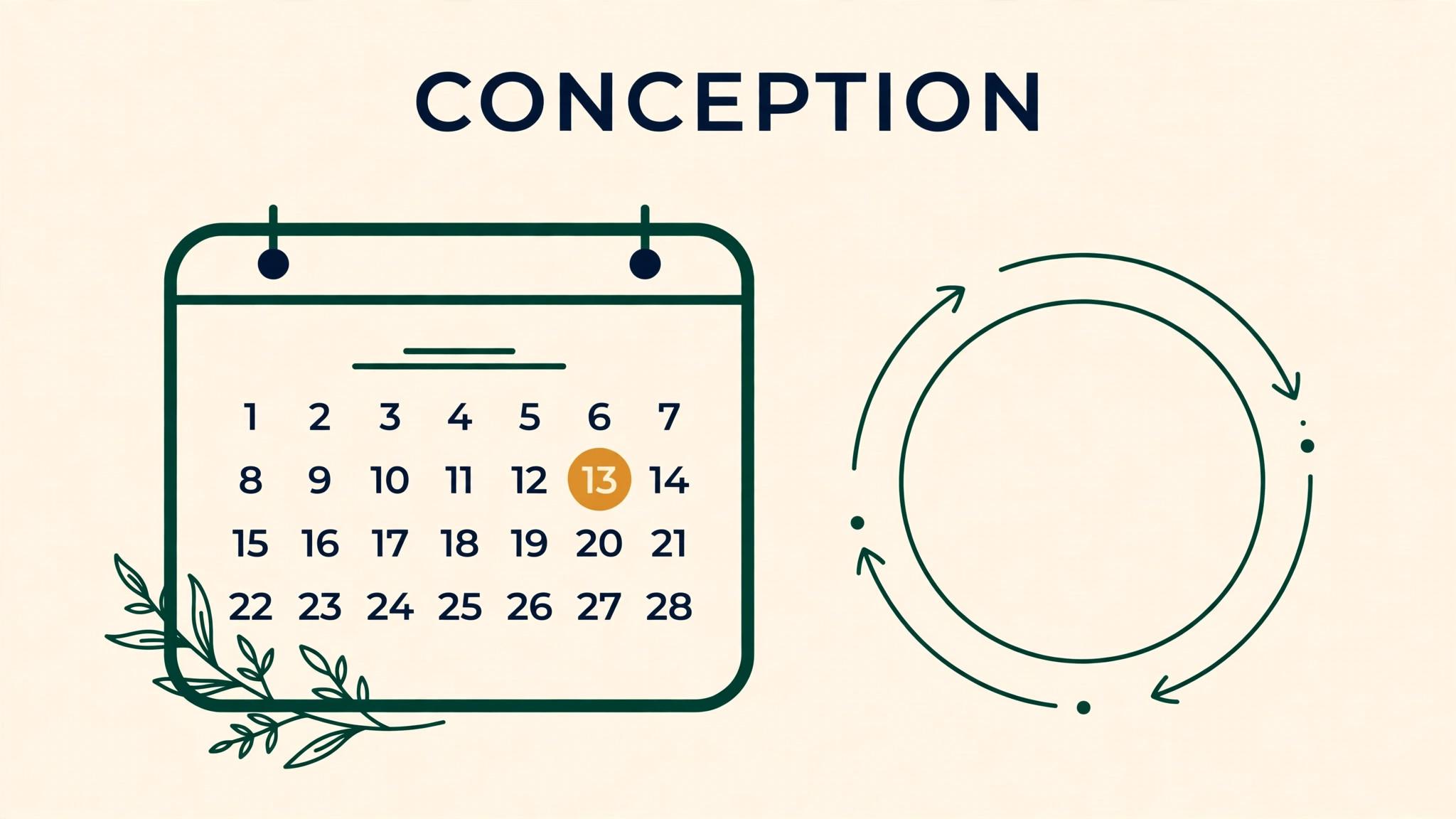
Featured image: custom illustration by Free Fitness Calculators.
A conception calculator estimates when conception is likely by working back from your last period. Ovulation usually falls 14 days before your next period, so the calculator places it at your last period plus your cycle length minus 14 days, then marks the five days around it — three days before ovulation to one day after — as your conception window.
How the calculator estimates conception
Conception can only happen around ovulation, when an egg is released from the ovary. The calculator needs just two inputs: the first day of your last menstrual period (LMP) and your average cycle length.
The key step is estimating ovulation. The second half of the cycle — the luteal phase, from ovulation to the next period — is the most stable part, lasting about 14 days. So the calculator estimates ovulation as LMP + cycle length − 14 days: day 14 in a 28-day cycle, day 18 in a 32-day cycle.
Around that estimated ovulation day, the calculator marks two windows. The conception window runs from 3 days before ovulation to 1 day after — the five days when conception is most likely, because sperm can survive for up to 5 days while the egg lives only 12 to 24 hours after release. The ovulation window is ovulation day plus or minus 2 days, allowing for natural variation.
It also gives three further dates: the earliest sensible day for a pregnancy test (ovulation + 10 days), the next expected period (LMP + cycle length), and — if conception happens this cycle — an estimated due date of ovulation + 266 days. Try it with your own dates in our conception calculator.
Worked example: last period 1 January 2026, 28-day cycle
Take a last period starting on 1 January 2026 and a regular 28-day cycle. Ovulation is estimated as 1 January + 28 − 14 days = 15 January 2026. Everything else follows from that one date:
| Date | What it is | Calculation |
|---|---|---|
| 12–16 January 2026 | Conception window | Ovulation −3 to +1 days |
| 13–17 January 2026 | Ovulation window | Ovulation ± 2 days |
| 15 January 2026 | Ovulation day | LMP + cycle length − 14 days |
| 25 January 2026 | Earliest pregnancy test | Ovulation + 10 days |
| 29 January 2026 | Next expected period | LMP + 28 days |
| 8 October 2026 | Estimated due date if pregnant | Ovulation + 266 days |
In a 32-day cycle with the same 1 January last period, ovulation is estimated on 19 January, the conception window runs 16–20 January, and the estimated due date becomes 12 October 2026. Assuming a 28-day cycle when yours is 32 days would put the window four days too early.
Due date from conception vs from your last period
There are two ways to date a pregnancy, and they differ by two weeks. The standard method, Naegele's rule, adds 280 days (40 weeks) to the first day of the last period. Counting from conception adds 266 days (38 weeks) — the same pregnancy minus the roughly 14 days between the last period and ovulation.
In the worked example, the two methods agree exactly: conception on 15 January plus 266 days gives 8 October 2026, and 1 January plus 280 days gives the same date. They agree only when ovulation really falls on day 14. When it does not, the conception-based date is the better estimate. If you know your actual conception date, enter it directly in our pregnancy due date calculator, which has a conception mode; our due date calculator guide explains both methods in full.
Why these dates are estimates, not certainties
Calendar maths assumes a regular cycle with ovulation exactly 14 days before the next period. Real cycles vary: stress, illness, travel and hormonal shifts can move ovulation by days, and in irregular cycles by much more. The calculator's dates are a planning aid, not a diagnosis — and they should never be used as contraception, since ovulation can shift without warning.
For dating a pregnancy, neither calendar method beats a scan. ACOG Committee Opinion No. 700 (2017) states that ultrasound measurement of the embryo in the first trimester — up to 13 weeks 6 days — is the most accurate method to establish gestational age, accurate to within 5–7 days. If a dating scan disagrees with the last-period date by more than 5–7 days, depending on gestation, the pregnancy is re-dated by the scan.
The biology behind the fertile window
The fertile window is short because the egg's life is short. Once released, an egg remains viable for only 12 to 24 hours. Sperm, by contrast, can survive for up to 5 days in fertile cervical mucus, which is why intercourse in the days before ovulation can still lead to conception. A study of 221 women trying to conceive, published in the New England Journal of Medicine, found conception occurred only when intercourse took place during the six-day period ending on ovulation day, with the chance rising from about 10% five days before ovulation to about 33% on the day itself.
Tracking physical signs helps narrow the estimate. Fertile cervical mucus turns clear and slippery, like raw egg white, near ovulation; basal body temperature rises by about 0.5–1.0°F the day after ovulation; and ovulation predictor kits detect the hormone surge preceding egg release by roughly 24–36 hours. For a fuller view of the fertile window, see our ovulation calculator and our ovulation calculator guide.
Frequently asked questions
How accurate is a conception calculator?
It is a good estimate for regular cycles and a rough one for irregular cycles. The maths assumes ovulation falls 14 days before the next period, which holds for many people but not all. Ovulation predictor kits or temperature tracking give a much firmer picture.
How is a due date calculated from conception?
Add 266 days (38 weeks) to the conception date — versus 280 days (40 weeks) from the first day of the last period. The two methods give the same date when ovulation falls on day 14 of a 28-day cycle.
When can I take a pregnancy test?
The calculator marks ovulation + 10 days as the earliest test date. Home tests detect hCG, which only rises to detectable levels after implantation, around 6–12 days after ovulation. Testing on the first day of a missed period gives a more reliable result.
Can I conceive on my period?
It is unlikely but possible with a very short cycle. In a 21-day cycle, ovulation can fall around day 7, and sperm from intercourse near the end of a period can survive long enough to meet the egg.
What if my cycles are irregular?
Use your average cycle length, but lean more on physical tracking — ovulation predictor kits, cervical mucus and basal temperature — and talk to a clinician if you have been trying for a year without success (six months if you are over 35).
This guide is general information, not medical advice. If you are trying to conceive and have questions about your cycle or fertility, talk to your doctor or another qualified health provider.