
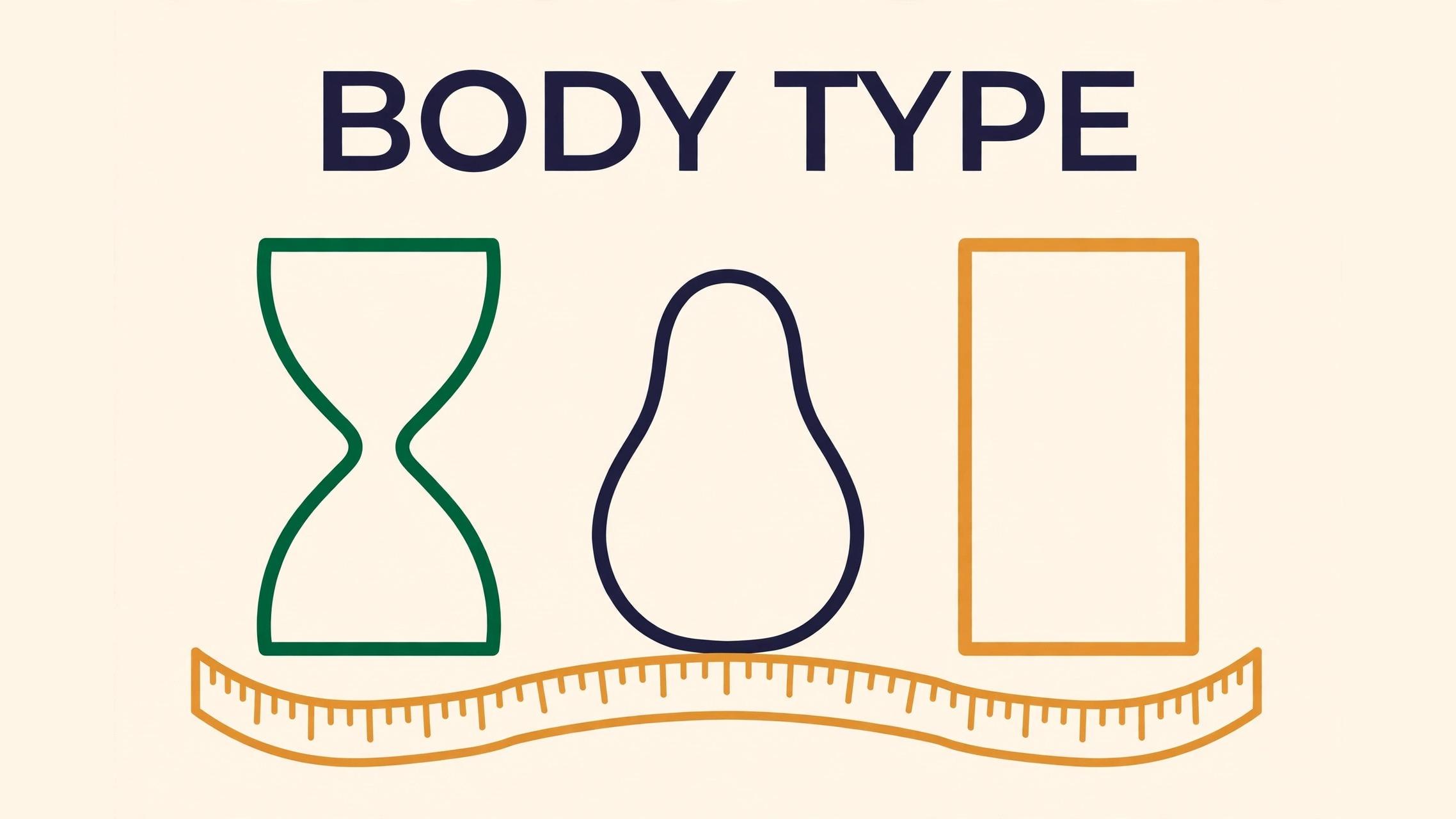
Featured image: custom illustration by Free Fitness Calculators.
Your body type is the shape your measurements make. Our body type calculator compares your bust, waist, high-hip and hip measurements and your waist-to-hip ratio to classify your silhouette as Hourglass, Pear, Apple, Rectangle, Inverted Triangle or Diamond, and matches the result to a somatotype — ectomorph, mesomorph or endomorph — with a macro split to suit it.
What your body type actually is
Two different ideas hide behind the phrase "body type". The first is your body shape: the geometry of your silhouette, decided by the relative sizes of your bust, waist and hips. The second is your somatotype: a metabolic category — ectomorph, mesomorph or endomorph — describing how easily you build muscle and store fat. Our calculator reports both, because shape on its own says little about how you should eat or train.
How to measure yourself
Your result is only as good as your measurements. Use a soft measuring tape, wear thin clothing or measure against bare skin, stand straight and breathe normally — never suck your stomach in. Keep the tape level and snug without compressing the skin, and measure each site twice.
Take four measurements. Bust or chest: around the fullest part. Natural waist: the narrowest part of your torso, just above the belly button. High hip: around the top of your pelvic bone, 3 to 4 inches below your waist. Full hip: around the widest part of your hips and buttocks, feet together. Enter all four in the same units — centimetres or inches.
How the calculator classifies your shape
Everything starts from your waist-to-hip ratio: waist circumference divided by hip circumference, both in the same units. A waist of 70 cm and hips of 98 cm gives a WHR of 0.71. Your bust and high-hip measurements then refine the result. Women and men are classified by different rules, because fat distribution differs by sex.
For women, the calculator checks the rules in order and takes the first match:
| Shape | Rule |
|---|---|
| Hourglass | WHR 0.75 or below, bust and hips close (within 4 cm or 8% of hip size) |
| Pear | WHR 0.80 or below, hips wider than bust |
| Apple (Round) | WHR above 0.85 |
| Triangle | WHR 0.75 or below, bust and hips far apart |
| Inverted Triangle | WHR 0.80 or above, bust over 4 cm wider than hips |
| Diamond | High hip and full hip differ by over 6 cm, WHR above 0.80, hips wider than bust |
| Rectangle | None of the above — bust, waist and hips roughly equal |
For men, the WHR alone decides it: 0.85 or below is an Inverted Triangle, 0.86–0.89 a Trapezoid, 0.90–0.94 a Rectangle, 0.95–1.00 Round, and above 1.00 a Triangle. The Rectangle band starts exactly at the WHO abdominal-obesity threshold of 0.90 for men — a man classified as Rectangle, Round or Triangle is above the line where metabolic risk is substantially higher.
Worked example: Hourglass and Rectangle
Take a woman with a bust of 92 cm, waist 70 cm, high hip 96 cm and hips 98 cm. Her WHR is 70 ÷ 98 = 0.71 — 0.75 or below — and her bust and hips differ by only 6 cm, less than 8% of her 98 cm hip measurement, so the calculator returns Hourglass. Her WHR is also comfortably below the WHO threshold of 0.85 for women.
Now take a man with a waist of 94 cm and hips of 102 cm. His WHR is 94 ÷ 102 = 0.92, in the 0.90–0.94 band, so the result is Rectangle — above the WHO threshold of 0.90 for men, the more important finding, since trimming his waist matters more for his health than the shape label. Check the ratio on its own with our waist-to-hip ratio calculator, and our waist-to-hip ratio guide explains the thresholds in full.
Somatotypes and your macro split
The calculator maps each shape to a somatotype. Hourglass, Inverted Triangle and Trapezoid map to mesomorph (athletic, builds muscle readily); Rectangle maps to ectomorph (lean, fast metabolism, gains weight slowly); Pear, Apple, Triangle, Diamond and Round map to endomorph (stores fat easily, gains muscle readily too). Somatotypes are a rough guide, not a diagnosis — most people sit between categories — but they give a useful starting point for nutrition.
| Somatotype | Protein | Carbs | Fat |
|---|---|---|---|
| Endomorph | 35% | 25% | 40% |
| Mesomorph | 30% | 40% | 30% |
| Ectomorph | 25% | 55% | 20% |
These are the splits the calculator returns with your result: more protein and fat and fewer carbs for endomorphs, more carbs to fuel growth for ectomorphs, a balanced split for mesomorphs. To turn the percentages into grams for your calorie target, use our macro calculator.
What your waist-to-hip ratio says about your health
The World Health Organization defines abdominal obesity as a WHR above 0.90 for men and above 0.85 for women. Above those lines, the risk of cardiovascular disease and type 2 diabetes rises substantially, because a high WHR signals visceral fat — fat packed around the liver and intestines, far more inflammatory than the subcutaneous fat stored under the skin of the hips and thighs. Risk climbs gradually, so a WHR of 0.88 beats 0.95 even though both sit above the threshold for women.
The evidence is large. INTERHEART, a case-control study of more than 27,000 people in 52 countries, found waist-to-hip ratio had a graded and highly significant association with heart attack risk, predicting it more strongly than BMI: the share of heart attacks attributable to a high WHR was 24.3%, against 7.7% for a high BMI. Shape labels are for styling; the ratio is the number worth tracking. For the wider picture, our body fat percentage calculator and body fat guide look beyond shape at composition.
Frequently asked questions
What is the difference between body shape and somatotype?
Body shape is the geometry of your silhouette — Hourglass, Pear, Apple and the rest — decided by your measurements. Somatotype is a metabolic category — ectomorph, mesomorph or endomorph — describing how easily you build muscle and store fat. The calculator reports both.
What is a healthy waist-to-hip ratio?
According to the World Health Organization, a healthy WHR is 0.85 or lower for women and 0.90 or lower for men. Above those thresholds, abdominal obesity is defined and the risk of cardiovascular disease and type 2 diabetes is substantially higher.
What is the rarest female body shape?
The true Hourglass is one of the least common shapes. It needs bust and hips nearly identical in size with a waist at least 25% smaller — the same definition this calculator applies: a WHR of 0.75 or below with bust and hips close in size.
Can I change my body type?
You cannot change your skeleton, but you can change your silhouette. Resistance training builds muscle where you want width, and fat loss lowers your waist-to-hip ratio — the change that improves your health outlook.
This guide is general information, not medical advice. If your waist-to-hip ratio is above the WHO threshold or you have concerns about your weight or heart health, talk to your doctor or a registered dietitian.