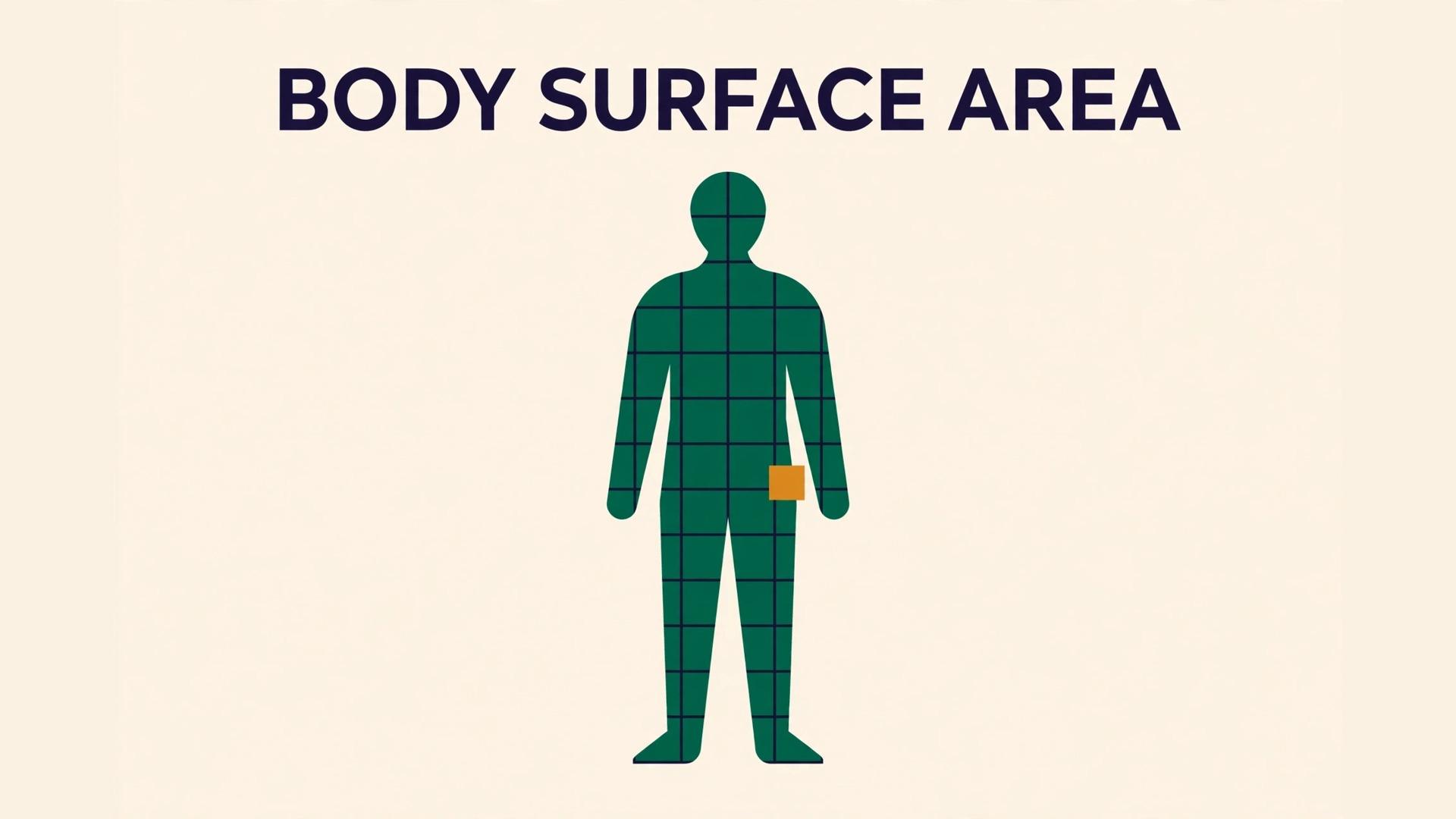
Featured image: custom illustration by Free Fitness Calculators.
Body surface area (BSA) is the total area of your skin, measured in square metres. A typical adult man is around 2.0 m² and a typical woman around 1.8 m²; a newborn is about 0.2 m². You cannot measure it directly without covering the body in paper moulds, so clinicians estimate it from height and weight — and the estimate decides drug doses, heart measurements and kidney function readings.
What body surface area is used for
BSA matters because many things in the body scale with surface area better than they scale with weight. The main uses are clinical. Chemotherapy and some other drugs are dosed per square metre — a dose written as 100 mg/m² means 100 mg for every square metre of your BSA, so a person with a BSA of 1.82 m² gets 182 mg. Cardiac output is often reported as cardiac index, which is cardiac output divided by BSA, so a big heart and a small heart can be compared fairly. Kidney function is reported as glomerular filtration rate per 1.73 m², the average adult BSA when the standard was set.
Outside hospitals, BSA shows up in metabolic calculations too: basal metabolic rate is sometimes expressed per square metre, because heat loss happens through the skin. For most people, though, BSA is a clinical number you will meet on a hospital chart rather than a fitness target. Our body type calculator covers the related question of frame and build, and our BMI guide explains the weight-for-height number most people actually track.
The formulas: Mosteller, Du Bois and Haycock
Every BSA formula has the same shape — a constant times height and weight raised to powers — because each was fitted to a different group of measured people. The three you will meet most often are:
| Formula | Year | Equation (H in cm, W in kg, BSA in m²) | Notes |
|---|---|---|---|
| Mosteller | 1987 | BSA = √(H × W ÷ 3600) | Simplest; the usual clinical default |
| Du Bois & Du Bois | 1916 | BSA = 0.007184 × H0.725 × W0.425 | The original; fitted to just 9 people |
| Haycock | 1978 | BSA = 0.024265 × H0.3964 × W0.5378 | Often preferred for children |
Mosteller is the one to remember. It came from a short 1987 letter to the New England Journal of Medicine in which Raymond Mosteller pointed out that the exponents in an earlier formula were both close to 0.5 — round them, and the formula becomes a square root you can do on any pocket calculator. It gives answers within about 2% of the fuller equations for typical adults, which is why it is now the most widely used formula for drug dosing.
Worked example: Mosteller by hand
Take a person 170 cm tall weighing 70 kg:
- Multiply height by weight: 170 × 70 = 11,900
- Divide by 3600: 11,900 ÷ 3600 = 3.306
- Take the square root: √3.306 = 1.82 m²
Du Bois gives 1.81 m² for the same person, and Haycock gives 1.83 m² — a spread of 0.02 m², about 1%, far too small to change a dose. A second example: at 175 cm and 85 kg, Mosteller gives √(175 × 85 ÷ 3600) = √4.132 = 2.03 m². Because Mosteller is a square root, quadrupling the weight only doubles the surface area — BSA grows much more slowly than weight, which is why dosing by surface area gives smaller people relatively larger doses than dosing by weight alone.
Body surface area by body size
The table below gives the Mosteller BSA at common heights and weights:
| Height | Weight | BSA (Mosteller) |
|---|---|---|
| 150 cm (4 ft 11 in) | 50 kg | 1.44 m² |
| 160 cm (5 ft 3 in) | 55 kg | 1.56 m² |
| 165 cm (5 ft 5 in) | 65 kg | 1.73 m² |
| 170 cm (5 ft 7 in) | 70 kg | 1.82 m² |
| 175 cm (5 ft 9 in) | 85 kg | 2.03 m² |
| 180 cm (5 ft 11 in) | 80 kg | 2.00 m² |
| 185 cm (6 ft 1 in) | 95 kg | 2.21 m² |
Two things stand out. First, the middle of the adult range is narrow: most adults sit between about 1.6 and 2.0 m², which is why 1.73 m² works as a standard reference. Second, height matters as much as weight: the 180 cm, 80 kg person has a larger BSA than the 175 cm, 85 kg person, even though they weigh less.
Which formula should you use?
For a typical adult it barely matters: at 170 cm and 70 kg, the common formulas all land between 1.81 and 1.83 m². Use Mosteller for a quick estimate and Du Bois when a protocol asks for it by name. The choice matters more at the extremes: in obesity, Du Bois reads below Mosteller by up to 3% in men and 5% in women, and for children Haycock is often preferred.
That disagreement is worth remembering whenever you see a BSA quoted to three decimal places: the number looks precise, but it is an estimate fitted to a sample, and different samples give different answers. A BSA of 1.818 m² is not more accurate than 1.82 m² — the extra digits are arithmetic, not measurement.
What BSA cannot tell you
BSA is a size number, not a health number. It says nothing about body composition: a muscular 90 kg person and a sedentary 90 kg person of the same height have the same BSA. It is not a fitness target, and there is no healthy range to aim for. Actual drug doses are set by a doctor or pharmacist who weighs the BSA estimate against kidney function, age, other medicines and the specific drug. Never use a BSA calculator to work out or adjust a real medication dose yourself. If you want a number that does describe health, our ideal weight guide explains the clinical weight formulas — and why the healthy BMI range is usually the better target.
Frequently asked questions
What is a normal body surface area?
Most adults fall between about 1.6 and 2.0 m². A typical man is around 2.0 m² and a typical woman around 1.8 m², with 1.73 m² used as the standard reference for kidney function. There is no ideal value — it scales with your height and weight.
How do I calculate BSA with the Mosteller formula?
Multiply your height in centimetres by your weight in kilograms, divide by 3600, and take the square root. For 170 cm and 70 kg: √(170 × 70 ÷ 3600) = 1.82 m².
Which BSA formula is most accurate?
None is clearly best for everyone. Mosteller is the most widely used because it is simple and agrees within about 2% of the others for typical adults. Du Bois is the oldest and most validated; Haycock is often preferred for children.
Can BSA be used to dose medicine at home?
No. BSA-based dosing, including chemotherapy dosed per square metre, must be worked out and verified by a licensed doctor or pharmacist. This guide is educational only.
This guide is general information, not medical advice. Talk to a doctor before changing your sleep, diet or exercise routine, especially if you have a health condition or take medication.