
Introduction
For decades, we've been told that our health journey is a battle against a single number: the one on the bathroom scale. We starve, we sweat, and we pray, all for that number to go down.
But what if that number is lying to you?
Consider two people, Alex and Ben. Both are 6 feet tall and weigh 190 pounds. According to a standard weight chart, they might both be considered "overweight." But Alex is a dedicated athlete with a 12% body fat percentage, carrying pounds of lean muscle. Ben is sedentary, rarely exercises, and has a 30% body fat percentage, carrying significantly more fat mass.
They weigh the same, but their health, metabolic rate, and physical appearance are worlds apart. The scale can't tell them apart. But body composition can.
Welcome to the ultimate body composition guide for 2026. This is the metric that matters. It’s the difference between "losing weight" and "getting fit."
In this comprehensive guide, we're going to pull back the curtain on what your weight is actually made of. You will learn:
What body composition is and why it's a more accurate measure of health than weight or BMI.
The science-backed body composition methods used by professionals, from high-tech DEXA scans to convenient home scales.
How to use a simple tape measure and our free body composition calculator tools to get a reliable estimate at home.
Actionable, science-backed strategies on how to improve body composition—not just lose weight, but build muscle and lose fat.
It's time to stop obsessing over the scale and start understanding your body.
What Is Body Composition?
In the simplest terms, body composition is a method of breaking down your total body weight into its different components. Think of it as your body's "ingredients list."
While a doctor can break this down into four components (water, protein, minerals, and fat), for fitness and general health, we primarily use a two-component model:
Fat Mass (FM): This is exactly what it sounds like—all the fat tissue in your body. This fat can be broken down further:
Essential Fat: This is the fat your body needs to survive. It’s found in your brain, bone marrow, nerves, and organs. It's crucial for hormone regulation and normal bodily functions.
Storage Fat (Adipose Tissue): This is the fat stored for energy. Some of it is subcutaneous (just under the skin), and some is visceral (deep in your abdomen, surrounding your organs).
Fat-Free Mass (FFM): This is everything else. It includes:
Muscle (Skeletal, Smooth, and Cardiac)
Bones
Organs
Water
Connective Tissues
Often, you'll hear the term Lean Body Mass (LBM) used interchangeably with FFM. While technically different (LBM includes essential fat), for our purposes, the key takeaway is the ratio of lean mass vs fat mass.
Shutterstock
A body composition analysis doesn't just tell you how much you weigh; it tells you what you're made of. And that single distinction is the key to unlocking real health.
Shareable Fact: Did you know? A pound of lean muscle is metabolically active, burning roughly 3-4 times more calories at rest than a pound of fat. This is why improving your body composition can turn your body into a more efficient, calorie-burning engine, 24/7.
Why Body Composition Matters More Than Weight
Let's go back to our friend "Sarah," a story we see every day.
Sarah decided to get healthy. She cut out junk food and started lifting weights three times a week. The first month, she was discouraged. The scale had barely moved—she'd only lost 2 pounds. She almost quit.
But then she took a progress picture. She looked visibly leaner. Her clothes fit better, and her arms had definition.
A body composition analysis told the real story: Sarah had actually lost 8 pounds of fat and gained 6 pounds of muscle. The scale only showed a 2-pound net loss, but she had undergone a dramatic body recomposition.
This is why body composition vs body fat (and vs. weight) is the superior metric.
1. It Reveals the "Skinny Fat" Phenomenon
You can have a "normal" weight and a "normal" Body Mass Index (BMI) but still be at high risk for health problems. This is known as "metabolically obese normal weight," or "skinny fat."
This person doesn't look overweight, but a body composition test would reveal a high percentage of visceral fat and low muscle mass. This combination is a silent risk factor for:
Insulin resistance and Type 2 Diabetes
High blood pressure
High cholesterol
Heart disease
Our BMI Calculator is a fantastic starting point—it's a globally recognized tool for assessing health risk on a population level. But body composition gives you the individual picture.
2. It Measures Real Progress
If you're only tracking weight, you'll be hopelessly lost.
Did you eat a salty meal? Your weight is up (water retention).
Did you have a hard workout? Your weight is up (muscle inflammation).
Are you on a crash diet? Your weight is down (but it's likely water and precious muscle).
Body composition tracks what matters. It's the only way to confirm you are losing fat and gaining (or at least preserving) muscle. This is the true goal of any smart fitness program.
3. It's Linked to Metabolic Health & Longevity
Your lean mass vs fat mass ratio is one of the strongest predictors of your metabolic health.
More Muscle: Better insulin sensitivity, which means your body handles carbohydrates better and has a lower risk of Type 2 Diabetes.
Less Visceral Fat: This is the "active" fat around your organs. Less of it means significantly lower inflammation and reduced risk of nearly every chronic disease.
More Muscle (Again): As you age, muscle mass (sarcopenia) is a leading indicator of frailty, falls, and mortality. Building and maintaining muscle is like investing in a "longevity 401k."
How Body Composition Is Measured
So, how to measure body composition? There is a wide range of body composition methods, from high-cost clinical gold standards to convenient at-home estimates.
Here’s a breakdown of the most common methods, from most to least accurate.
1. DEXA (Dual-Energy X-ray Absorptiometry)
What it is: This is the current "gold standard" for body composition analysis. You lie on a table for about 10-15 minutes while a scanner passes over your body, using low-dose X-rays.
How it works: It provides a detailed three-component breakdown: bone mineral density, fat mass, and lean mass. It can even tell you the precise distribution of fat and muscle in each limb.
Pros: Extremely accurate, provides bone density data, and shows regional distribution.
Cons: Very expensive ($100-$300+ per scan), requires a clinical or lab setting, and is not easily accessible.
2. Hydrostatic Weighing (Underwater Weighing)
What it is: The "old" gold standard before DEXA. It involves being submerged in a large tank of water while sitting on a special scale.
How it works: It's based on Archimedes' principle. Since fat is less dense than water and muscle is denser, a person with more fat will weigh less underwater (be more buoyant).
Pros: Very accurate when performed correctly.
Cons: Extremely inconvenient, uncomfortable for many (you must exhale all air from your lungs underwater), and very hard to find.
3. Bioelectrical Impedance Analysis (BIA)
What it is: This is the technology used in most body composition scales (like Fitindex, Renpho, or Withings) and handheld devices.
How it works: A BIA device sends a tiny, imperceptible electrical current up one leg and down the other. Muscle, which is ~70% water, conducts this current easily (low impedance). Fat, which has very little water, resists it (high impedance). The scale's algorithm uses this resistance reading to estimate your body fat composition.
Pros: Extremely fast, easy, affordable, and can be done daily at home.
Cons: Accuracy can be highly variable. It is massively affected by your hydration level, whether you've eaten, if you've exercised, and even your body temperature.
4. Skinfold Measurements
What it is: A trained technician uses a tool called a "caliper" to pinch your skin and the underlying subcutaneous fat at several (usually 3, 7, or 9) specific sites on your body.
How it works: The measurements (in millimeters) are plugged into a formula (like the Jackson-Pollock equation) to estimate your overall body fat percentage.
Pros: Very inexpensive, portable, and can be quite accurate.
Cons: Its accuracy is 100% dependent on the skill of the tester. It's also harder to get consistent readings on very lean or very obese individuals and doesn't measure visceral (internal) fat.
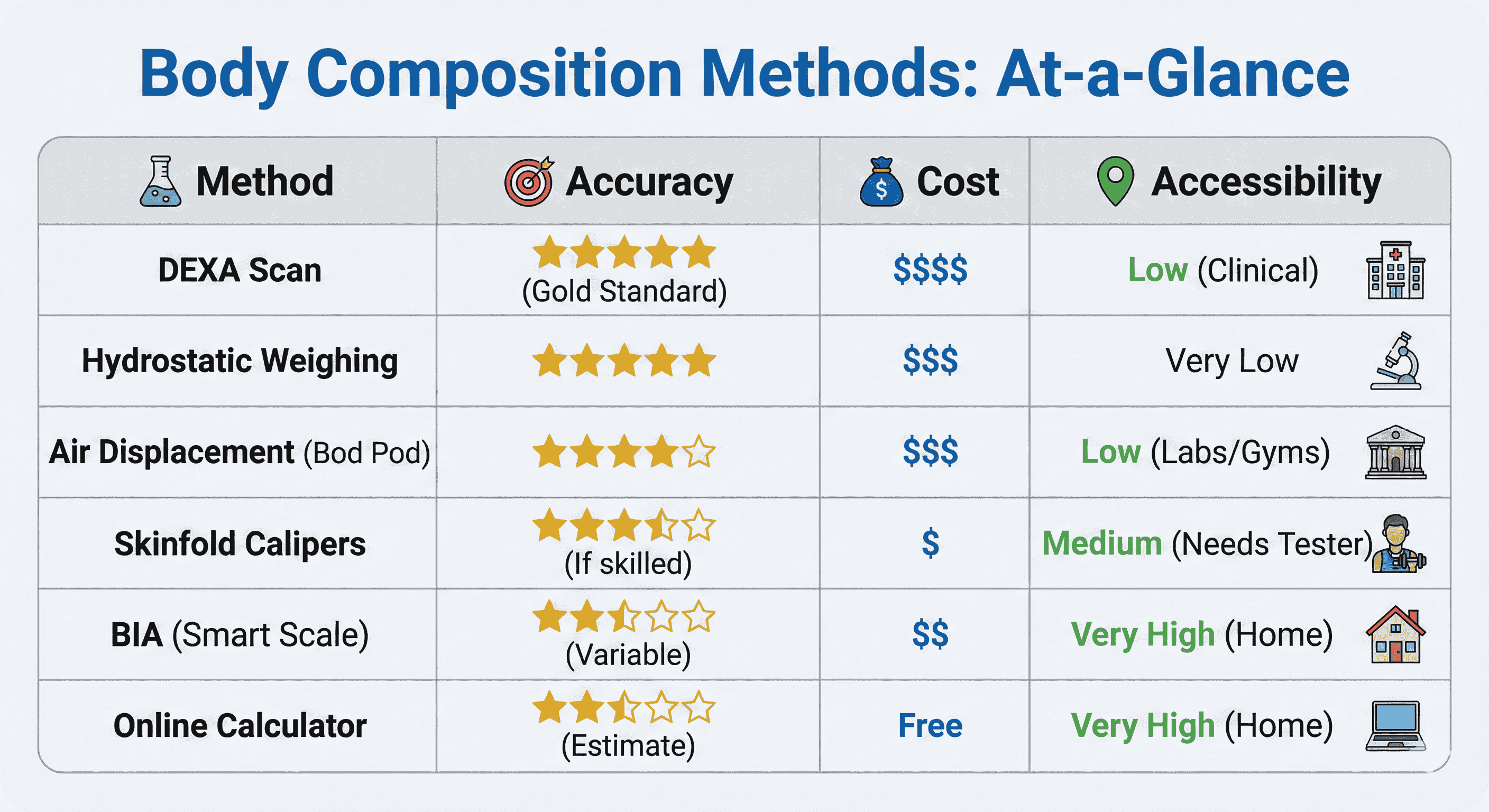
Body Composition Methods: At-a-Glance
Method | Accuracy | Cost | Accessibility |
DEXA Scan | ★★★★★ (Gold Standard) | $$$$ | Low (Clinical) |
Hydrostatic Weighing | ★★★★★ | $$$ | Very Low |
Air Displacement (Bod Pod) | ★★★★☆ | $$$ | Low (Labs/Gyms) |
Skinfold Calipers | ★★★☆☆ (If skilled) | $ | Medium (Needs Tester) |
BIA (Smart Scale) | ★★☆☆☆ (Variable) | $$ | Very High (Home) |
Online Calculator | ★★☆☆☆ (Estimate) | Free | Very High (Home) |
How to Calculate Body Composition Online
You don't need a $150 DEXA scan to start tracking your progress, especially when you're just beginning. A consistent estimate that you can track over time is often more valuable than a single, ultra-accurate reading.
This is where online calculators become powerful tools. They use formulas developed by researchers that are based on simple body measurements.
At FreeFitnessCalculators.com, we provide the tools you need to get a comprehensive baseline for free.
Body Fat Calculator: This is your primary tool. We use the U.S. Navy Method, one of the most reliable estimation formulas available. It requires just a tape measure and a few simple measurements (typically neck, waist, and for women, hips). Use this calculator to find your starting body fat composition.
Ideal Weight Calculator: Once you have a body composition goal, how does that translate to the scale? Our Ideal Weight Calculator uses several popular formulas (like Robinson, Miller, and Hamwi) to give you a healthy weight range based on your height and frame size. This helps you set a realistic goal.
BMI Calculator: As we discussed, BMI isn't the whole story, but it's an important part of it. Use our BMI Calculator to see where you fall on the universal health spectrum. If your BMI is high and your body fat is high, it's a strong signal to take action.
Body Surface Area Calculator: This is a more clinical tool, often used to calculate drug dosages and medical metrics. However, it's another interesting way to understand your body's complete metrics and how they relate to health.
Ideal Body Composition Charts
"Okay, I've got my number. What is a 'good' body composition percentage?"
This is one of the most common questions we get. The truth is, your ideal body composition depends heavily on your gender, age, and personal goals (e.g., are you a competitive athlete or just looking to be healthy and fit?).
Men naturally have a lower body fat percentage than women due to hormonal differences and the fact that women carry essential fat in areas like the breasts, pelvis, and thighs.
Age also plays a role. It's natural for body fat to increase slightly as we get older, though much of this can be mitigated with diet and exercise.
To make this simple, we've created the Body Balance Chart™. This table shows you the generally accepted healthy body fat percentage ranges.
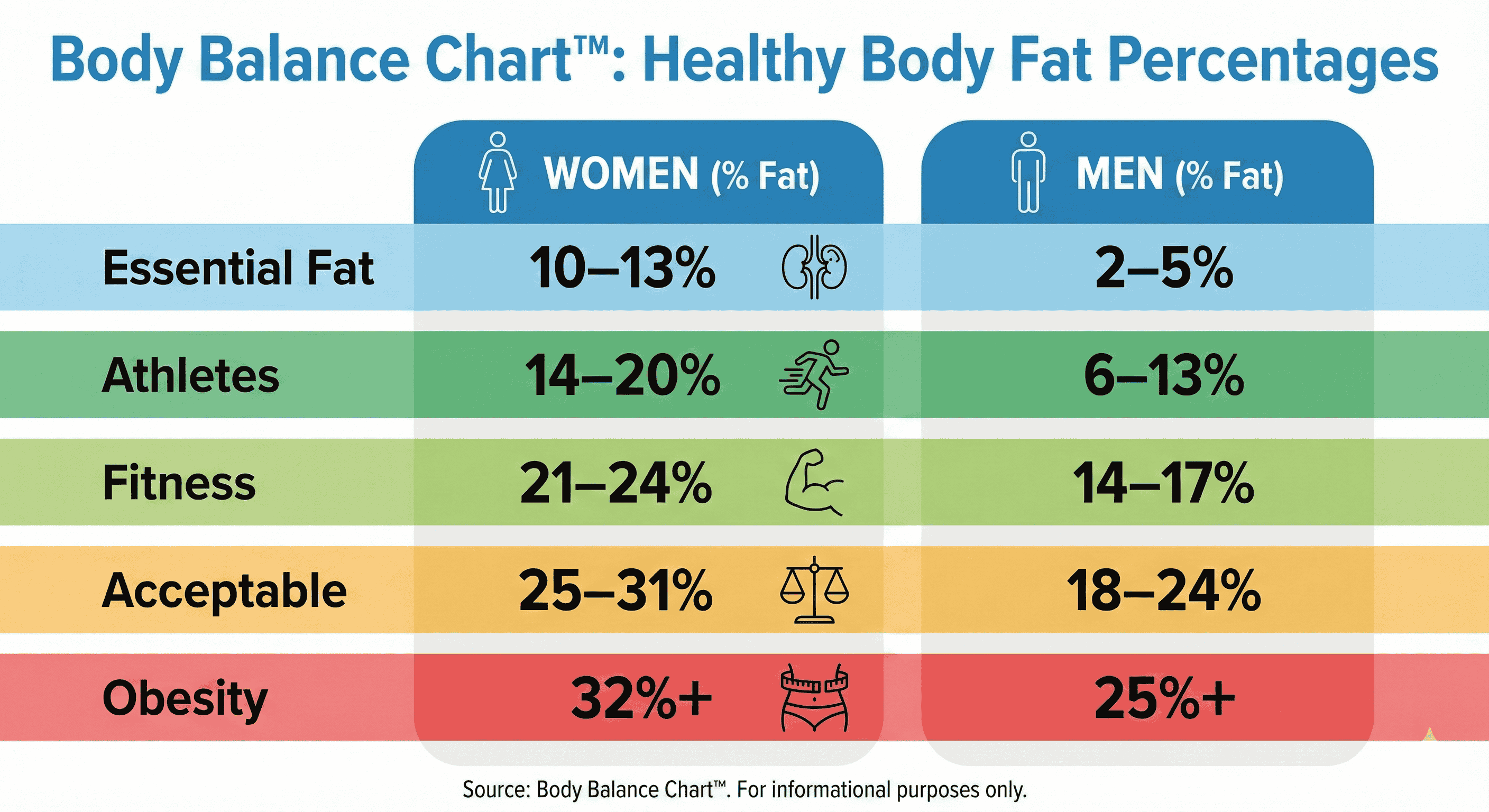
Body Balance Chart™: Healthy Body Fat Percentages
Classification | Women (% Fat) | Men (% Fat) |
Essential Fat | 10-13% | 2-5% |
Athletes | 14-20% | 6-13% |
Fitness | 21-24% | 14-17% |
Acceptable | 25-31% | 18-24% |
Obesity | 32%+ | 25%+ |
Find your number on this body composition chart. This gives you a much better target than an arbitrary number on the scale. For most people, a good goal is to move from "Obesity" or "Acceptable" into the "Fitness" range.
Body Composition vs Body Fat vs BMI
Let's clear up the confusion between these three terms once and for all.
Think of your health metrics like a car:
BMI (Body Mass Index): This is the car's total weight. A 5,000 lb vehicle could be a large, safe SUV... or it could be a small, rusty pickup truck filled with lead. BMI tells you how heavy you are for your height, but not what that weight is made of.
Body Fat Percentage: This is like knowing the weight of the cargo versus the weight of the engine. It's a hugely important ratio. A car with too much cargo and a tiny engine won't perform well.
Body Composition: This is the full blueprint of the car. It tells you the weight of the engine (muscle), the frame (bones), the electrical system (organs), and the cargo (fat). It's the complete, detailed picture of your health and performance potential.
The key difference between body composition vs body fat is that "body fat %" is just one part of a full body composition analysis. The full analysis also tells you about your lean mass, bone density, and water content.
DIY: How to Estimate Body Composition at Home
You don't need fancy equipment. For tracking progress, consistency beats clinical accuracy every time. Here are three simple ways for how to measure body composition at home.
1. The Tape Measure Method (Recommended)
This is the most reliable and consistent at-home method. It tracks where you are losing or gaining inches, which is a direct indicator of body recomposition.
How: Go to our Body Fat Calculator and follow the simple instructions.
Step 1: Get a flexible tailor's tape (not a metal construction one).
Step 2: For men, measure your neck (at the Adam's apple) and your waist (at the navel).
Step 3: For women, measure your neck, your "natural waist" (the narrowest point), and your hips (the widest point).
Step 4: Plug these numbers into the body fat calculator online.
Pro Tip: Measure every 2-4 weeks, at the same time of day (e.g., Sunday morning). Write it down. You're looking for the trend, not a single-day reading.
2. The Smart Scale (BIA) Method
If you own a body composition scale, it can be a useful tool if you understand its limitations.
How: Step on the scale.
The #1 Rule: ABSOLUTE CONSISTENCY. The BIA reading is highly sensitive. To make it useful for tracking, you must weigh yourself under the exact same conditions every time.
First thing in the morning.
After using the restroom.
Before eating or drinking anything.
Naked.
Pro Tip: Ignore the daily number. It will fluctuate wildly. Instead, look at the weekly average. Is your average this week lower than your average last week? That's progress.
3. The Mirror and Photo Method
This is the "old school" method, and it's surprisingly effective.
How: Once a month, take progress photos in the same outfit, same lighting, and same poses (front, side, back).
Why it works: The mirror and photos don't lie. You will see body recomposition happening. You'll notice more definition in your shoulders, a tighter waist, and more shape in your legs long before the scale or even the tape measure shows a dramatic change.
How to Improve Body Composition
This is the most important part of this guide. How to improve body composition is not about "dieting." It's about changing your body's ratio of muscle to fat.
This process is called body recomposition, and it relies on three pillars. You must do all three.
1. Nutrition: The Foundation
You can't out-train a bad diet. Nutrition provides the building blocks for muscle and the fuel for fat loss.
Prioritize Protein: This is the non-negotiable, #1 rule. Protein provides the amino acids needed to repair and build muscle. When you're in a calorie deficit to lose fat, a high-protein diet signals to your body to keep the muscle and burn the fat.
Action: Aim for 0.7 to 1 gram of protein per pound of your goal body weight. (e.g., if you want to be 150 lbs, aim for 105-150g of protein). Use our Protein Intake Calculator to find your exact needs.
Control Calories (Slightly): To lose fat, you need to be in a slight calorie deficit. To build muscle, you need to be at maintenance or in a slight surplus. For body recomposition, the "sweet spot" is often right around maintenance or a very small deficit (200-400 calories). Check your TDEE to start.
Focus on Food Quality: Ditch the processed junk. Build your meals around:
Protein (see above)
Fiber (vegetables, fruits, legumes)
Healthy Fats (avocado, olive oil, nuts, seeds)
2. Exercise: The Signal
If nutrition is the "building blocks," exercise is the "construction crew" that tells your body what to build.
Strength & Resistance Training: This is the most critical part. Lifting weights (or doing bodyweight exercises) is the signal that tells your body, "We need this muscle! Don't burn it! Build more!" This is what separates simple "weight loss" from body recomposition.
Action: Aim for 2-4 full-body strength workouts per week. Focus on compound movements that use multiple muscle groups, as these are the best body composition exercises:
Squats
Deadlifts (or hip hinges)
Push-ups (or bench press)
Overhead Press
Rows
Cardiovascular Exercise: Cardio is fantastic for heart health, endurance, and burning extra calories. A mix of steady-state (e.g., a 30-min jog) and high-intensity (e.g., 15 minutes of sprints) is a great addition, but it should be secondary to your strength training.
3. Recovery: Where the Magic Happens
You don't build muscle in the gym. You build it when you rest.
Sleep: This is your body's prime repair time. When you sleep, your body releases human growth hormone (HGH) and repairs the muscle fibers you broke down.
Action: Aim for 7-9 hours of quality sleep per night. It's just as important as your diet and workout. Check our Sleep Quality Index to assess your rest.
Hydration: Your muscles are about 70% water. Even slight dehydration can hurt your performance, slow recovery, and (bonus!) completely skew your body composition scale reading. Use the Water Intake Calculator to stay on track.
Stress Management: High chronic stress (from work, life, etc.) raises the hormone cortisol. Cortisol can encourage fat storage (especially visceral belly fat) and promote muscle breakdown.
Body Composition for Athletes
For athletes, body composition isn't just about health—it's about performance. The ideal body composition for athletes varies dramatically by sport.
Endurance Athletes (Runners, Cyclists): The goal is an optimal power-to-weight ratio. They aim for very low body fat while maintaining just enough lean mass in the legs and core for power, without carrying "extra" muscle mass that costs energy to move.
Strength/Power Athletes (Powerlifters, Strongmen, Sprinters): The goal is maximum lean mass. A higher body fat composition is often acceptable (and sometimes even beneficial for leverage in lifting), as long as it's supported by a massive amount of muscle.
Aesthetic Athletes (Bodybuilders, Fitness Models): This group takes body recomposition to the extreme. Their entire sport is about maximizing muscle and minimizing body fat to achieve a specific look. They often reach unsustainably low body fat levels for competition day—proving that "visible" doesn't always equal "healthy."
Common Myths About Body Composition
Let's bust a few common myths that stop people from making real progress.
Myth 1: You can "spot reduce" fat.
Truth: You cannot do 1,000 crunches to burn belly fat. Your body loses fat systemically, from all over, based on your genetics. Crunches will build your ab muscles, but the fat covering them is only lost through a consistent calorie deficit.
Myth 2: "Muscle weighs more than fat."
Truth (and a great Shareable Fact!): This is technically false. A pound is a pound! A pound of muscle weighs exactly the same as a pound of fat. The real difference is density. A pound of muscle is sleek and dense (like a small brick), while a pound of fat is fluffy and takes up 3-4 times more space (like a pile of cotton balls). This is why Sarah looked so different after gaining 6 lbs of muscle and losing 8 lbs of fat—she got smaller and denser.
Myth 3: "Cardio is the best way to lose fat."
Truth: Cardio is a great tool for burning calories, but it does very little to change your body composition. Strength training is what builds or preserves muscle, which, as we learned, raises your metabolism and creates a lean, toned physique. The best plan uses both.
Myth 4: "A body composition scale is 100% accurate."
Truth: As discussed, bioimpedance analysis is a good estimate, but it's easily fooled by hydration. Don't live and die by the number. Use it for the weekly trend only.
Frequently Asked Questions (FAQs)
Q: How to measure body composition most accurately?
A: The most accurate method is a DEXA scan, which you can get at specialized clinics. For practical, at-home tracking, the most accurate and consistent method is using a tape measure with our Body Fat Calculator every 2-4 weeks.
Q: What is a good body composition percentage?
A: It depends on your goals! For general health and fitness, a great range to aim for is 21-24% for women and 14-17% for men. Refer to our Body Balance Chart™ in this article to see where you fall.
Q: How often should I check my body composition?
A: Don't obsess. If you're using a clinical method like DEXA, once every 6-12 months is plenty. If you're using at-home methods like a smart scale or tape measure, check every 2-4 weeks. This is long enough to see a real trend and short enough to keep you motivated.
Q: What’s the best way to improve body composition?
A: The "trifecta" of body recomposition:
Eat Enough Protein: Aim for 0.7-1g per pound of your goal body weight.
Lift Weights: Do 2-4 strength training sessions per week.
Get 7-9 Hours of Sleep: Recovery is when you rebuild.
Conclusion: Stop Guessing, Start Measuring
The bathroom scale has been a cruel, misleading partner for too long. It only tells you how much you weigh. It knows nothing about your health, your strength, or the amazing changes you're making.
Body composition tells the truth. It tells you what you're made of.
You are now equipped with the knowledge to track your health with scientific precision. You know the body composition methods, you have the body composition charts, and you have the actionable plan on how to improve body composition.
The first step to improving any metric is to measure it. Knowledge is power, and the first piece of knowledge you need is your baseline.
Stop guessing. Start your journey today. Grab a tape measure and visit our free Body Fat Calculator to get your starting number. Then, head to our Ideal Weight Calculator to set a realistic goal.
It's time to build a stronger, healthier you.