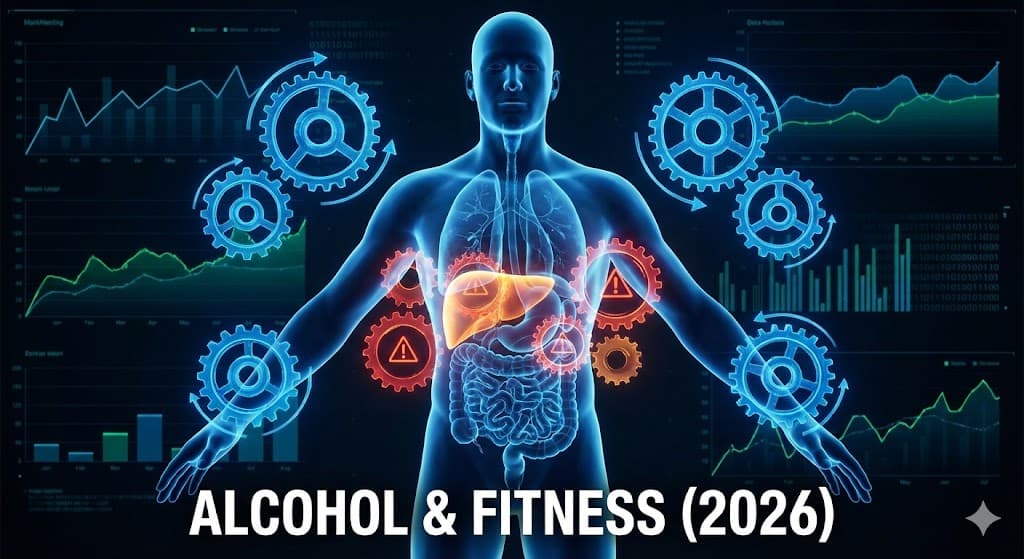
Introduction: The Invisible Progress Killer
You track every gram of protein. You wake up at 5:00 AM for fasted cardio. You measure your sleep quality and obsess over your rep ranges. But on Friday night, you have "just a few drinks" with friends. By Monday, your weight is up, your strength is down, and you look softer in the mirror.
You aren't imagining it. And no, it’s not just "water retention."
In the fitness world, we are taught to worship the holy trinity of nutrition: Protein, Carbs, and Fats. But there is a fourth macronutrient—Alcohol—and it plays by a completely different set of biological rules. It is arguably the single most disruptive force to your metabolic health, yet it is the least understood.
Most people think alcohol is bad simply because it contains "empty calories." This is a massive oversimplification. The caloric load is the least of your worries. The real problem is biochemical. Alcohol is a metabolic hijacker that pauses fat loss, crashes testosterone, and inhibits the very pathways responsible for building muscle.
The Promise: We are not here to lecture you on morality or tell you to never drink again. We are here to teach you the science of ethanol metabolism. In this 2026 guide, we will strip away the myths and give you the data you need to minimize the damage, using tools like our BAC Calculator to time your recovery perfectly.
Chapter 1: The "Fourth Macro" (Understanding Alcohol Energy)
To understand why alcohol impacts your physique, you first need to understand its energy density. We are trained to look at food labels, but alcohol bottles rarely list nutrition facts. This lack of transparency leads to massive overconsumption.
The Energy Hierarchy
Let’s look at the caloric density of the nutrients you consume:
Protein: 4 calories per gram (High Thermic Effect)
Carbohydrates: 4 calories per gram (Variable Energy)
Alcohol (Ethanol): 7 calories per gram (Toxin)
Fats: 9 calories per gram (Stored Energy)
Alcohol is nearly twice as calorie-dense as carbohydrates and protein. It sits dangerously close to pure fat. But unlike the other three, alcohol is not an essential nutrient. Your body has no storage mechanism for it. You can store carbs as glycogen and fat as adipose tissue, but you cannot store alcohol.
The "Obligatory" Fuel Source
This is the critical concept: Alcohol calories are obligatory.
Because your body views ethanol as a poison (specifically, a cellular toxin), clearing it becomes the biological priority. Your liver drops everything else it is doing to process the alcohol.
Imagine your metabolism is a highway. Usually, fat and carbs are the cars driving down the road. When alcohol enters the system, it’s like an emergency ambulance with sirens blaring. All other traffic (fat burning and carb oxidation) must pull over and stop completely until the ambulance passes.
The Metabolic Pause: While alcohol is in your system, your Lipid Oxidation (Fat Burning) rates drop to near zero. If you consume enough alcohol to keep your Blood Alcohol Content (BAC) elevated for 10 hours, you have effectively pressed "pause" on fat loss for 10 hours. Every gram of fat or carbohydrate you ate that day is pushed into storage because your metabolic machinery is occupied with the alcohol.
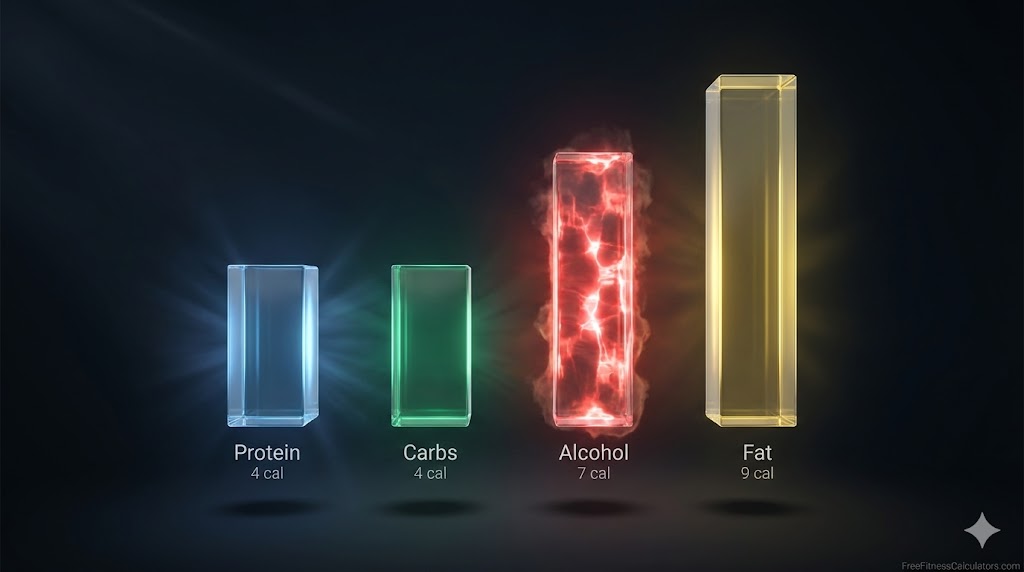
Visual Description: A 3D bar chart comparing the caloric density of macros. The Alcohol bar (7 cal/g) should be highlighted in red warning colors, standing taller than Protein and Carbs.
Chart showing alcohol has 7 calories per gram compared to 4 for protein and carbs.
Alcohol is closer to fat in caloric density than it is to carbohydrates.
Chapter 2: The Science of Sobering Up (Zero-Order Kinetics)
"I'll just drink a lot of water and sweat it out." "I'll eat some bread to soak it up."
We have all heard these myths. They are scientifically false. To understand why, you must understand the unique way the human liver functions.
First-Order vs. Zero-Order Kinetics
Most substances in your body follow First-Order Kinetics. This means the more you consume, the faster your body works to clear it. If you eat a massive 2,000-calorie meal, your metabolism ramps up (Thermic Effect of Food) to process it.
Alcohol follows Zero-Order Kinetics.
The Rule: Your liver can only process a fixed amount of alcohol per unit of time, regardless of how much you drink.
The Rate: For the average human, this clearance rate is approximately 0.015 g/dL per hour (roughly one standard drink per hour).
The Bottleneck: It does not matter if you drink 1 beer or 10 beers; your liver cannot work faster. It is limited by the availability of an enzyme called Alcohol Dehydrogenase.
Why You Can't "Hack" Sobriety
Because of Zero-Order Kinetics, there is a linear timeline for recovery that you cannot cheat.
If your BAC Calculator says you are at 0.10%, and your clearance rate is 0.015% per hour, it will take roughly 6.6 hours to reach zero.
Drinking water dilutes the blood volume slightly and helps dehydration, but it does not speed up the enzyme activity.
Eating food slows absorption, but it does not increase the elimination rate once the alcohol is in the blood.
Cold showers and coffee increase alertness, but they do not lower BAC.
This is why understanding your BAC is a fitness tool, not just a legal one. If you have a heavy leg day planned for 8:00 AM, and you are drinking until 2:00 AM, the math of Zero-Order Kinetics guarantees you will still have alcohol in your system during your squats.
Action Step: Use our BAC Calculator right now to see how long it actually takes to clear different amounts of alcohol based on your body weight.
Chapter 3: The Muscle Killer (Testosterone & mTOR)
If metabolic pausing wasn't enough, alcohol also wages a direct war on your endocrine system (hormones) and your anabolic signaling pathways. If your goal is hypertrophy (muscle growth), alcohol is the ultimate antagonist.
1. mTOR Inhibition: Blocking the Signal
Muscle growth happens via a cellular pathway called mTOR (Mammalian Target of Rapamycin). Think of mTOR as the "General Contractor" that tells your body to build new muscle tissue after a workout.
Research published in PLOS One and other physiological journals has shown that alcohol is a potent inhibitor of mTOR.
The Study: One landmark study showed that consuming alcohol after a workout reduced Muscle Protein Synthesis (MPS) by 24% to 37%, even when protein was consumed alongside it.
The Reality: If you train hard on Friday afternoon and drink heavily that night, you have mathematically wasted about one-third of that workout. You did the damage (lifting), but you chemically blocked the repair (growth).
2. The Testosterone Crash
Testosterone is the primary driver of muscle repair, fat loss, and recovery. Alcohol acts as a testicular toxin.
Leydig Cell Damage: Ethanol damages the Leydig cells in the testes, which are responsible for producing testosterone.
The Timeline: Moderate to heavy drinking can lower testosterone levels for up to 24 hours after drinking ceases.
Estrogen Spike: Chronic consumption increases aromatase activity, the enzyme that converts testosterone into estrogen. This is the primary mechanism behind "beer belly" accumulation and gynecomastia (man boobs) in heavy drinkers.
3. The Cortisol Spike
While testosterone drops, Cortisol (the stress hormone) spikes.
High Cortisol + Low Testosterone = Catabolism.
This state forces your body to break down muscle tissue for energy and store energy as visceral fat (fat around the organs). This is why the "skinny fat" physique is so common among weekend binge drinkers.
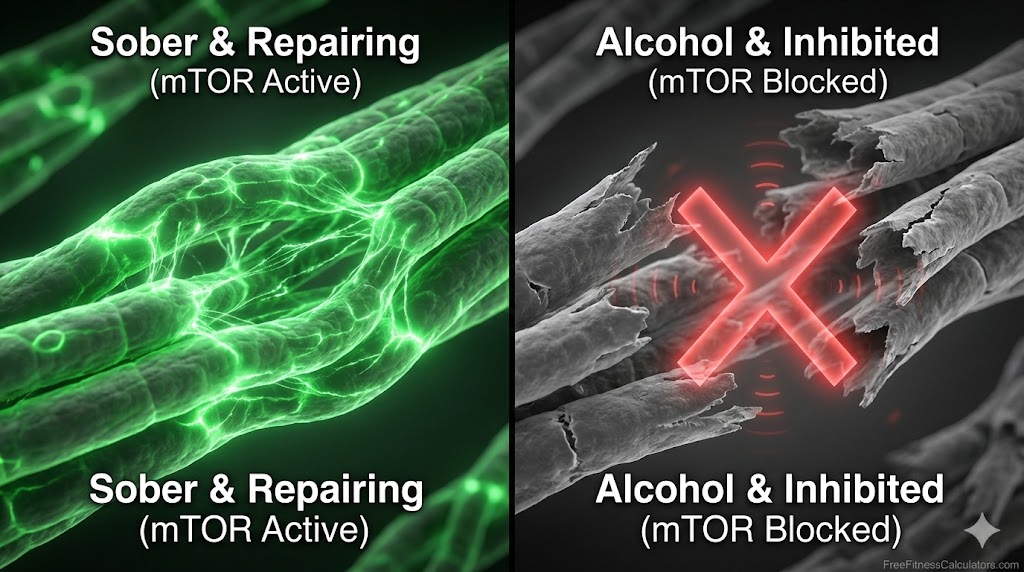
Visual Description: A split comparison diagram. Left side shows a "Sober Recovery" muscle fiber with active mTOR signals (green arrows). Right side shows "Alcohol Recovery" with blocked mTOR signals (red X) and Cortisol attacking the tissue.
Diagram showing how alcohol blocks mTOR pathways and stops muscle protein synthesis.
Alcohol doesn't just halt fat loss; it actively blocks the chemical signals required to build muscle.
Chapter 4: How to Use the BAC Calculator for Recovery
Most people use a BAC Calculator to answer one question: "Can I drive?" As a fitness enthusiast, you should use it to answer a different question: "When is my metabolism back to normal?"
We call this the Metabolic Clearance Timeline.
The Protocol: Timing Your Return to Training
You cannot train effectively while your body is detoxifying. Training with alcohol in your system increases dehydration, risk of injury (due to poor motor control), and cortisol spikes.
Step 1: Calculate Your Peak Before you go out, or while you are out, enter your data into the BAC Calculator:
Inputs: Your weight, gender, number of drinks, and time elapsed.
Result: Let’s say you are a 180lb male who had 5 drinks. Your estimated BAC is 0.08%.
Step 2: Calculate the "Zero Hour" Look at the "Time to Sobriety" metric. If the calculator says "5 Hours," that means your body is occupied with detox until that moment.
Example: If you stop drinking at midnight, you are not biologically sober until 5:00 AM.
Step 3: The Training Rule Rule: Do not attempt high-intensity training (HIIT) or heavy compound lifting until you have been at 0.00% BAC for at least 4 hours.
If your "Zero Hour" is 5:00 AM, your metabolic machinery isn't ready for heavy squats until 9:00 AM at the earliest. Training before this window is often "junk volume"—high stress, low adaptation.
Chapter 5: Sleep, HGH & The "Fake" Recovery
"I sleep like a rock after drinking." No, you don't. You sedate yourself. There is a massive biological difference between sedation and sleep.
The REM Suppression
Alcohol is a sedative that helps you lose consciousness faster (reduced sleep latency), but it destroys your sleep architecture. Specifically, it suppresses REM (Rapid Eye Movement) sleep.
REM is crucial for cognitive recovery and mental focus.
Fragmented sleep leads to increased insulin resistance the next day.
The HGH Blockade
Human Growth Hormone (HGH) is the "fountain of youth" hormone responsible for cell regeneration and fat burning.
The Peak: HGH is primarily released during the first few cycles of Slow Wave Sleep (Deep Sleep).
The Alcohol Effect: Studies suggest that alcohol consumption can reduce HGH secretion by up to 70% during the night. By destroying your deep sleep cycles, you miss your nightly window of natural performance enhancement.
The Fix: If you have been drinking, do not rely on "feeling" rested. Use our Sleep Quality Calculator (PSQI) to assess your true fatigue levels, and check your Sleep Debt to plan a recovery nap.
Chapter 6: The "Fit Drinker's" Strategy Guide
We are realists. You are going to drink at weddings, parties, and social events. Here is the Damage Control Protocol to ensure one night out doesn't ruin your physique.
1. The Pre-Game Buffer (Fat & Protein)
Never drink on an empty stomach. When the stomach is empty, alcohol rushes into the small intestine and is absorbed rapidly, spiking your BAC.
Strategy: Eat a meal high in Protein and Fiber before your first drink.
Why: Protein induces satiety, and fiber physically slows gastric emptying. Use the Protein Calculator to ensure you hit your daily macro goal before you start drinking.
2. The Dilution Ratio
The solution to pollution is dilution.
The Rule: 1 Drink = 1 Glass of Water.
The Math: If you have 4 cocktails (roughly 12oz total volume), you need to consume at least 12oz of water between those drinks.
Hydration Tool: Check your baseline needs with the Water Intake Calculator and add 12oz for every alcoholic beverage consumed.
3. Drink Choice: The "Congener" Factor
Congeners are chemical byproducts of fermentation that worsen hangovers.
Best Choices (Low Congener): Vodka, Gin, Tequila, White Rum. Mix with soda water and fresh lime (low calorie, low sugar).
Worst Choices (High Congener/Calorie): Dark Rum, Whiskey, Red Wine, and sugary cocktails. These combine the alcohol "metabolic pause" with a massive insulin spike from sugar.
4. Supplementation
Before Bed: Take Magnesium and Zinc. Alcohol depletes these essential minerals rapidly. Zinc is a co-factor for the alcohol dehydrogenase enzyme.
Next Morning: Electrolytes (Sodium/Potassium) are more effective than plain water for rehydrating cellular volume.
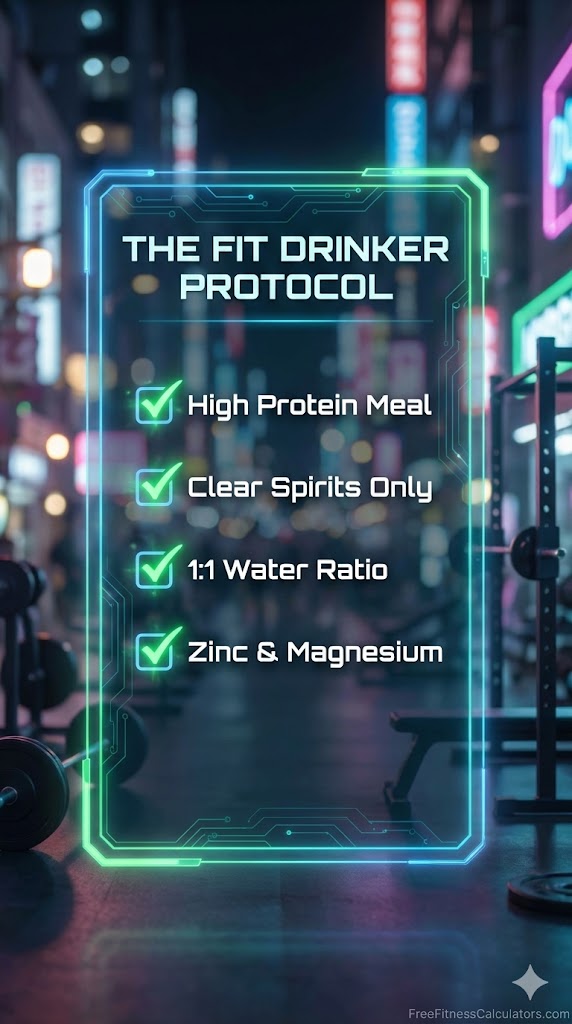
Visual Description: A checklist graphic titled "The Fit Drinker's Checklist." Items include: "High Protein Dinner," "Clear Spirits Only," "1:1 Water Ratio," "Zinc/Magnesium Before Bed."
Checklist for minimizing fitness damage while drinking alcohol.
Screenshot this checklist for your next night out.
Chapter 7: Myths vs. Reality
Let's finally put these gym-bro myths to rest.
Myth 1: "I can sweat it out in the sauna."
Reality: False. Only about 2-5% of alcohol leaves the body through sweat, breath, and urine. The other 95% must be metabolized by the liver. Sweating just dehydrates you further, putting immense stress on your kidneys.
Myth 2: "Coffee sobers you up."
Reality: False. Caffeine blocks adenosine receptors in the brain, making you feel alert. It does nothing to lower blood alcohol concentration. You are simply a wide-awake drunk person with slow reaction times.
Myth 3: "Beer is good post-workout carbs."
Reality: False. While beer contains carbohydrates, the alcohol content inhibits glycogen replenishment and muscle repair. It is an inefficient and counter-productive fuel source.
FAQ Section
Q: Will one night of drinking ruin my cut? A: One night won't ruin a cut, but it can stall it for 2-3 days. The combination of the "metabolic pause" and water retention can mask fat loss for up to 72 hours. Don't panic; get back to your TDEE limits immediately.
Q: How long after drinking can I take creatine? A: You can take creatine anytime, but alcohol is a diuretic, and creatine requires water to hydrate muscle cells. If you take them together without massive water intake, you risk cramping and bloating.
Q: Does alcohol affect my metabolic age? A: Yes. Chronic inflammation, liver stress, and visceral fat accumulation (all side effects of heavy drinking) are key factors in aging your metabolism. Use our Metabolic Age Calculator to see where you stand today.
Conclusion: Data Beats Guilt
Alcohol is part of the social fabric of life. We aren't telling you to become a monk. However, in the world of fitness, data beats guilt.
If you choose to drink, do it with your eyes open. Understand the cost—not just in dollars, but in testosterone, sleep quality, and fat-burning time. By using tools like the BAC Calculator and the strategies in this guide, you can enjoy your life without sacrificing your hard-earned progress.
Your Action Plan:
Calculate: Know your limit before you sip.
Hydrate: Match every drink with water.
Recover: Don't train heavy until you are biologically sober.